
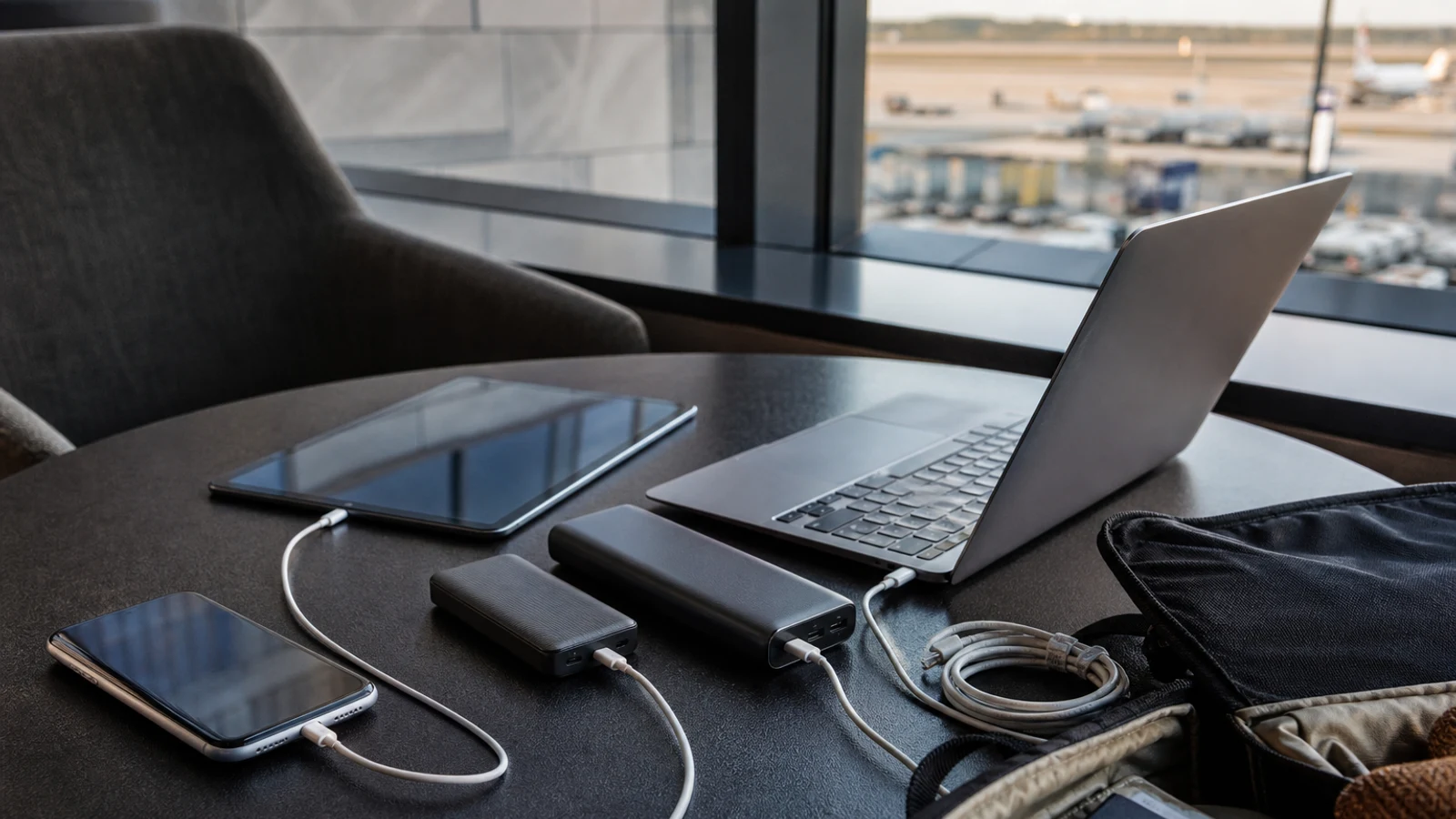
For most travelers carrying a phone, tablet, or USB-C laptop, the Anker Laptop Power Bank (25K, 165W) is the most balanced choice because it combines high capacity, built-in cables, 100W USB-C output, and a sub-100Wh battery rating. Choose the Anker Nano 10K 45W for a smaller everyday bag, the Anker MagGo 10K for Qi2 wireless charging, or the Statik SmartCharge Pro if you want a power bank that also works as a wall charger and international travel adapter.
How We Chose These Travel Power Banks
This is a research-based buying guide, not a report of hands-on testing. The selections reflect current manufacturer specifications and recent independent product coverage, with priority given to models that offer a practical combination of capacity, USB-C Power Delivery, portability, and travel-friendly features.
A power bank's capacity is usually listed in milliamp-hours, but watt-hours are more useful for air travel. Under current FAA guidance, spare lithium-ion batteries and power banks must be carried in your cabin baggage. Batteries up to 100Wh are generally allowed, while larger units require airline approval and remain subject to carrier policies. Check the airline's rules before departure, especially if you plan to carry more than one power bank.
- Phone-only travelers usually need 10,000mAh and do not need a 100W laptop charger.
- Tablet and laptop users should look for USB-C PD output of at least 45W to 65W, depending on the device.
- A 20,000mAh to 26,000mAh bank offers more reserve but adds noticeable weight.
- Built-in cables reduce packing clutter but cannot be replaced as easily as a separate cable.
1. Anker Laptop Power Bank (25K, 165W): Best Overall For Mixed Devices
The Anker Laptop Power Bank (25K, 165W, Built-In and Retractable Cables) is the strongest all-around choice for travelers who carry more than a phone. It combines a 25,000mAh capacity with three USB-C charging connections, two built-in cables, a USB-A port, a smart display, and up to 100W from a single USB-C connection. Its total output reaches 165W when charging multiple devices.
The built-in and retractable cables are particularly useful on flights, trains, and airport lounges where a loose charging cable is easy to misplace. The capacity is also large enough for extended trips or a laptop emergency, while remaining below the common 100Wh airline threshold according to the manufacturer's stated battery rating.
The drawback is weight. At roughly 21 ounces, this is much heavier than a phone-focused 10,000mAh model. It is best for a backpack, work bag, or carry-on rather than a pocket or minimalist day bag.
- Best for: Travelers carrying a laptop, tablet, phone, and accessories.
- Why it stands out: Two built-in cables, 100W USB-C output, and strong multi-device flexibility.
- Limitation: Heavy for casual phone charging.
2. Anker Prime Power Bank (26K, 300W): Best For High-Power Laptops
The Anker Prime Power Bank (26K, 300W) is the power-user option. It has a 26,250mAh capacity, two USB-C ports, one USB-A port, a detailed display, app control, and up to 140W from a single USB-C port. Its combined output is rated up to 300W, making it suitable for charging several demanding devices at once.
This is the better pick than the 165W Anker when you regularly carry a powerful laptop, a tablet, and a phone and want maximum output headroom. It also supports very fast recharging when both USB-C inputs are used with compatible chargers and cables, which can matter during a short hotel stop or airport layover.
The trade-off is size, price, and weight. At about 1.3 pounds, it is not a compact travel accessory. The high output is also unnecessary for travelers who only need to recharge a phone and earbuds.
- Best for: High-performance laptops and several devices charging together.
- Why it stands out: 140W single-port output and 300W total output.
- Limitation: Expensive and bulky compared with ordinary travel power banks.
3. UGREEN Nexode Power Bank 25,000mAh 200W: Best Anker Alternative
The UGREEN Nexode Power Bank 25,000mAh 200W is a strong alternative for travelers who want high output without choosing an Anker model. It supports up to 200W total output, includes a smart digital display, can charge three devices, and uses USB-C Power Delivery 3.1 for compatible laptops and tablets.
Its 25,000mAh capacity gives it enough reserve for long travel days and laptop top-ups. The display is useful because it shows more than a simple four-light indicator, helping you judge whether the remaining charge is sufficient before leaving an airport or hotel. UGREEN also lists a 65W recharge capability, which is more useful than a slow overnight refill.
The limitation is portability. At roughly 609 grams, it belongs in a backpack or laptop bag. It is also more power than most phone travelers need, and the maximum output does not guarantee that every laptop will accept the full rating. The computer's charging requirements and the cable used still matter.
- Best for: Travelers who want high capacity and multi-device USB-C charging.
- Why it stands out: 200W total output, display, and broad laptop compatibility.
- Limitation: Heavy and excessive for phone-only trips.
4. Anker Nano Power Bank 10K 45W: Best Compact Wired Pick
The Anker Nano Power Bank 10K 45W with Built-In Retractable USB-C Cable is the most practical choice for travelers who mainly carry a phone but want enough output for a tablet or small USB-C laptop in an emergency. It has a 10,000mAh capacity, a retractable USB-C cable, an additional USB-C port, a USB-A port, and up to 45W output.
Its size is the main attraction. The bank is far easier to slip into a small sling, purse, or seat-back pocket than a 20,000mAh laptop bank. The built-in cable also eliminates one of the easiest travel items to forget. A display provides a more precise view of the remaining charge than basic indicator lights.
The capacity is the compromise. A 10,000mAh power bank is suitable for a day of phone navigation, photos, messaging, and transit tickets, but it is not the right choice for repeated laptop charging or a long trip away from outlets.
- Best for: Phone-first travelers who want a compact bank with useful USB-C speed.
- Why it stands out: Retractable cable and 45W output in a smaller format.
- Limitation: Limited reserve for laptops and multi-day travel.
5. Anker MagGo Power Bank 10K: Best For Qi2 Wireless Charging
The Anker MagGo Power Bank 10K is the convenience pick for compatible iPhones and other Qi2 devices. It supports Qi2 wireless charging, includes a foldable stand, has a smart display, and provides wired USB-C charging when you need more speed or want to charge a nonmagnetic device.
Wireless charging is useful when you are walking through an airport or using your phone for maps, because you can attach the battery without managing a cable. The stand also makes it useful on a tray table or hotel nightstand. The USB-C port gives the bank a wired fallback for phones, earbuds, and smaller accessories.
Wireless charging is less efficient than a direct cable connection, so this model will not deliver the same practical energy as a similarly rated wired bank. It is also less suitable for laptops and may require a compatible magnetic case or device for secure attachment.
- Best for: Qi2-compatible iPhone users who prioritize cable-free convenience.
- Why it stands out: Magnetic Qi2 charging plus a foldable stand and display.
- Limitation: Wireless charging wastes more energy and is not a laptop solution.
6. UGREEN Nexode Power Bank 12,000mAh 100W: Best Smaller Laptop-Capable Option
The UGREEN Nexode Power Bank 12,000mAh 100W is an unusual middle ground. It is smaller than a typical laptop power bank but offers enough USB-C output for many tablets and compatible laptops. Its display shows the remaining charge, and its compact shape makes it easier to carry on short business trips or day excursions.
This is a good option when you want more capability than a basic 10,000mAh phone bank without carrying a 20,000mAh or 25,000mAh brick. The 100W rating also gives it useful headroom for fast USB-C charging, although the actual speed depends on the laptop, cable, and charging protocol.
The major limitation is that its two-port behavior can be restrictive. When both USB-A and USB-C are used, the available output is substantially reduced. It is best viewed as a strong single-device charger rather than a full multi-device power hub.
- Best for: Short trips with one laptop, tablet, or phone as the main device.
- Why it stands out: Small format with up to 100W USB-C output.
- Limitation: Shared output drops sharply when both ports are used.
7. Statik SmartCharge Pro 15,000mAh: Best All-In-One Travel Charger
The Statik SmartCharge Pro 15,000mAh combines a power bank with a built-in USB-C cable, wireless charging, a wall charger, and interchangeable US, UK, Australian, and European plug adapters. It is designed for travelers who want one device to cover hotel-room charging and portable backup power.
Its 60W USB-C output is enough for many phones, tablets, and some USB-C laptops, while the built-in adapters can reduce the number of separate charging accessories in your bag. The wireless charging pad adds convenience for compatible phones, and the 15,000mAh capacity is a reasonable compromise between phone reserve and portability.
The all-in-one design creates trade-offs. It is thicker than a simple battery pack, and integrated adapters are less flexible than carrying a separate high-quality wall charger. Wireless charging is also slower and less efficient than using the USB-C cable.
- Best for: International travelers who want a power bank and wall charger together.
- Why it stands out: Built-in cable, wireless charging, and multiple plug adapters.
- Limitation: Thicker and less modular than separate charging gear.
What To Look For Before You Buy
Start with the devices you actually carry. If your trip involves a phone, earbuds, and occasional navigation, a 10,000mAh bank is usually easier to live with. If you need to extend laptop use, move to 20,000mAh or more and check the laptop's required charging wattage before buying.
Do not confuse a high total wattage with high single-port wattage. A bank advertised at 200W or 300W may deliver much less from one port. For a laptop, the single-port USB-C rating is the specification that matters most. A 45W bank may handle a lightweight laptop slowly, while a 65W or 100W bank is a safer match for larger USB-C computers.
Capacity also declines in practical use because of voltage conversion and charging losses. A 25,000mAh power bank will not deliver 25,000mAh directly to a phone battery. Treat capacity as reserve energy, not a guaranteed number of full device charges.
Finally, pack the right cable. A power bank cannot deliver its rated wattage through a cable that lacks the required current rating, and some laptops will not charge at full speed with low-power USB-C cables. Keep the bank in your carry-on, protect its ports from metal objects, and check your airline's current rules before flying.
- Check the laptop's required wattage, not just the bank's total wattage.
- Prefer a clearly stated USB-C PD rating for tablets and laptops.
- Consider weight: high-capacity models can add more than a pound to a day bag.
- Use a cable rated for the power level you intend to draw.
- Never place a spare power bank in checked baggage.
Questions & Answers
Practical follow-up questions readers often ask before acting or buying.
What size power bank is best for travel?
For phone-focused travel, 10,000mAh is usually the best balance of size and reserve. Choose 20,000mAh to 26,000mAh if you need to recharge a tablet, extend laptop use, or stay away from outlets for a full day or longer.
Can I bring a power bank on a plane?
Yes, spare power banks generally must be carried in your carry-on baggage rather than checked luggage. The FAA generally allows lithium-ion power banks up to 100Wh per battery, while larger batteries may require airline approval. Confirm the current policy with your airline.
Can a power bank charge a laptop?
Yes, if the laptop accepts USB-C charging and the power bank supports sufficient USB-C Power Delivery output. Check the laptop's charger wattage and compare it with the bank's single-port output, not only its total output.
Is 100W enough for a laptop power bank?
For many ultrabooks and tablets, 65W to 100W is sufficient. Larger workstation or gaming laptops may need more, may charge slowly, or may not charge while under heavy load. The computer's own charging requirements determine compatibility.
Are wireless power banks good for travel?
They are convenient for compatible phones, especially when navigating or moving through an airport, but wireless charging is generally less efficient than using a cable. They are not a substitute for a high-output wired power bank when charging laptops or tablets.
How many power banks can I take on a flight?
The watt-hour rating and airline policy matter more than the milliamp-hour number. The FAA allows power banks within the applicable battery limits, but airlines can impose additional restrictions, so check the carrier's current rules before packing multiple units.
Sources & Further Reading
Airline Passengers and Batteries | Federal Aviation Administration
Anker Nano USB-C Fast Charger (45W) - Anker US
Anker MagGo Power Bank (10K) - Anker US
Eco-Friendly 10000 mAh 20W PD Portable Charger | Nimble CHAMP
UGREEN 130W Power Bank 20000mAh - Fast Charging for Laptops – UGREEN US
Anker 737 Power Bank (PowerCore 24K) - Anker US
Anker Prime Power Bank (27K, 250W) - Anker US
Shargeek 170 Power Bank 24,000mAh Power Bank 170W Output IP66 Water Resistant – SHARGE