
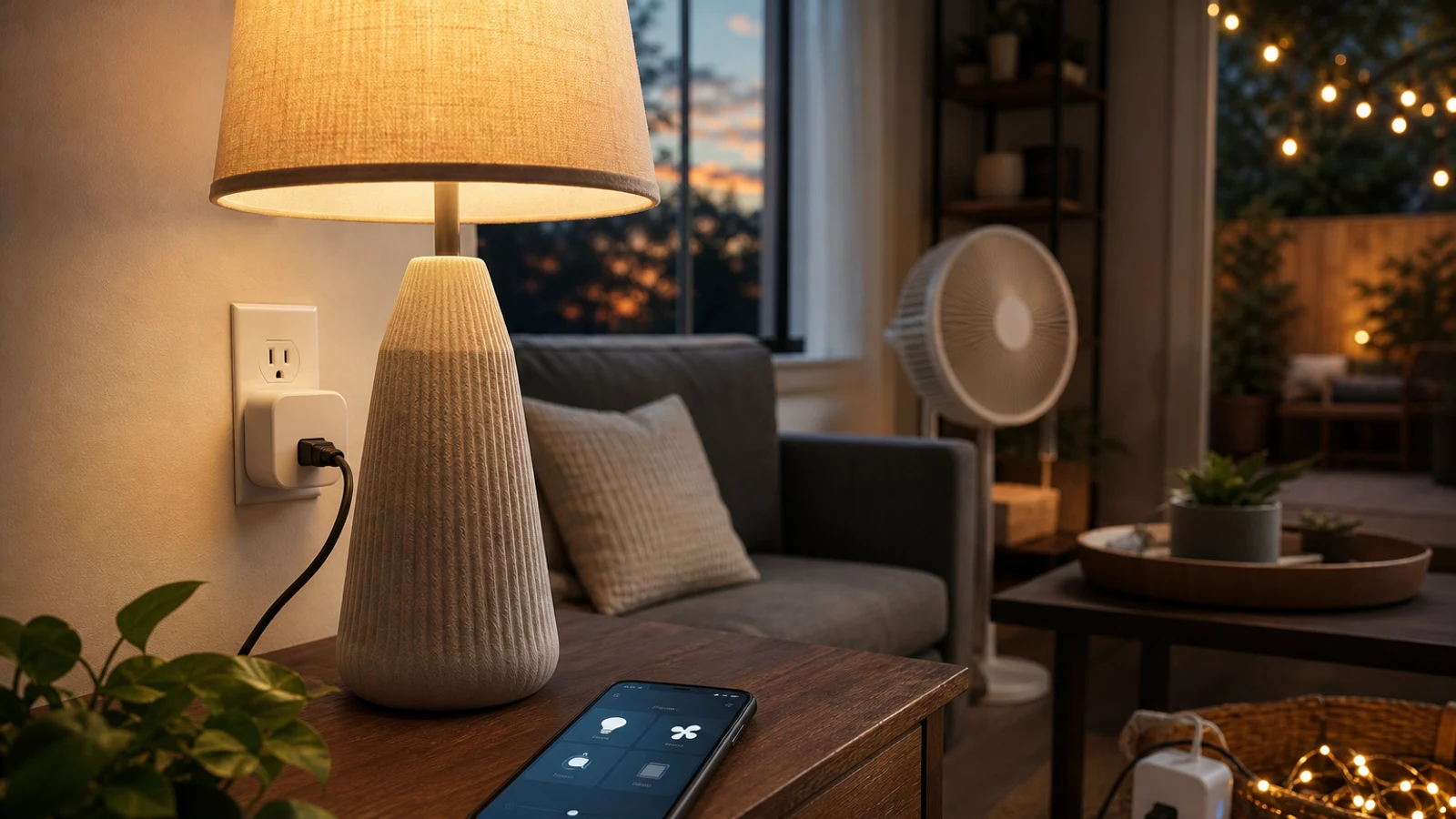
For most homes, the TP-Link Tapo P110M is the strongest all-around choice because it combines Matter compatibility, energy monitoring, and broad platform support. Choose the TP-Link Kasa KP125M if you want a compact plug with energy tracking, the Tapo P125M for affordable Matter control without monitoring, Eve Energy for Thread and privacy, or the Tapo P400M for outdoor devices.
How We Chose
This is a research-based buying guide, not a report from hands-on testing. The picks reflect manufacturer specifications, platform compatibility, product documentation, and recent smart-home coverage. Each model is matched to a specific buying situation rather than presented as best for every home.
Wi-Fi plugs are usually easiest because they connect directly to a home network. Thread plugs can offer efficient local networking but require compatible infrastructure, while Matter can reduce ecosystem lock-in without eliminating setup requirements. Energy monitoring matters when you want to understand appliance consumption; outdoor models require attention to weather resistance, outlet covers, cable placement, and independent control.
- Best overall: TP-Link Tapo P110M
- Best compact all-rounder: TP-Link Kasa KP125M
- Best budget Matter plug: TP-Link Tapo P125M
- Best Thread and privacy pick: Eve Energy
- Best Matter multipack: Meross MSS115
- Best outdoor smart plug: TP-Link Tapo P400M
- Best for Alexa beginners: Amazon Smart Plug
1. TP-Link Tapo P110M: Best Overall
The TP-Link Tapo P110M is the most balanced choice for shoppers who want more than remote on-and-off control. It combines Matter support with energy monitoring and broad compatibility across Apple Home, Alexa, Google Home, and Samsung SmartThings, making it practical for mixed-platform households.
Its energy monitoring is the main reason to choose it over a basic Matter plug. The Tapo app can track connected-device consumption and help build schedules around the results. That is useful for devices such as fans, compatible space heaters, or entertainment equipment.
It may be more feature-rich than necessary for a lamp or simple holiday-light schedule. Matter setup still depends on the controller and app ecosystem, and Wi-Fi smart plugs generally require a reliable 2.4GHz network.
Best for: Energy monitoring and broad smart-home compatibility. Skip it if you only need the cheapest basic timer.
- Matter support for major smart-home platforms
- Energy monitoring through the Tapo ecosystem
- Good fit for mixed-platform households
- Requires 2.4GHz Wi-Fi and careful Matter setup
2. TP-Link Kasa KP125M: Best Compact All-Rounder
The Kasa KP125M is a strong alternative to the Tapo P110M for shoppers who prefer the Kasa app and ecosystem. It offers Matter compatibility, energy monitoring, voice control, scheduling, and a slim design intended to preserve access to the neighboring outlet in many installations.
Its compactness is useful behind furniture or in a crowded power strip, where a bulky plug can block a second receptacle. It still provides usage information and app-based automation.
The main drawback is overlap with TP-Link’s Tapo range. Some energy information may be most convenient in the manufacturer’s app rather than every Matter platform. It is also not an outdoor plug.
Best for: A compact indoor plug with monitoring and Matter. Skip it if you want outdoor control or do not care about energy data.
- Compact indoor form factor
- Matter and energy monitoring
- Works with major voice-assistant ecosystems
- Not weather-resistant and not intended for outdoor use
3. TP-Link Tapo P125M: Best Budget Matter Plug
The Tapo P125M suits shoppers who want Matter compatibility without paying for energy monitoring they will not use. It can automate a lamp, fan, or compatible small appliance through schedules, timers, app commands, and voice control.
Its strength is simplicity. For a bedside lamp, decorative light, or basic away routine, it avoids features that do not change the decision. Matter also provides broader compatibility than a plug tied to one platform.
The trade-off is that it cannot track electricity use. It depends on Wi-Fi and the Matter controller or ecosystem used during setup, but its lower-feature approach makes sense when you need several simple automations.
Best for: Affordable Matter-based schedules and voice control. Skip it if energy monitoring is a deciding feature.
- Simple Matter-compatible control
- Good for lamps, fans, and routine schedules
- No energy monitoring
- Wi-Fi setup may be less appealing to local-control enthusiasts
4. Eve Energy: Best for Thread and Privacy
Eve Energy is the specialist pick for shoppers who want Thread networking, Matter support, energy monitoring, and a privacy-focused operating model. Eve states that the plug does not require an Eve cloud account or subscription and works across Apple Home, Alexa, Google Home, Samsung SmartThings, and Home Assistant when the required equipment is available.
Compatible powered devices can participate in a Thread mesh rather than relying only on Wi-Fi. Eve Energy can also act as a Thread router, making it more interesting than a basic Wi-Fi plug in a deliberately planned smart-home system.
The catch is setup complexity. Eve Energy needs a compatible hub and Thread border router, depending on the platform, so it is not automatically the easiest first plug. Its premium positioning makes most sense when privacy, local operation, or Thread is important.
Best for: Apple Home users, privacy-conscious households, and Thread-based systems. Skip it if you want the least complicated Wi-Fi setup.
- Matter over Thread
- Energy monitoring and local-focused operation
- No Eve cloud account or subscription required
- Requires compatible hub and Thread infrastructure
5. Meross MSS115: Best Matter Multipack
The Meross MSS115 is useful when you need several basic smart plugs at once. The US version is sold as a two-pack and uses Matter over 2.4GHz Wi-Fi, supporting major smart-home platforms and local Matter control rather than relying entirely on a proprietary cloud service.
A multipack suits similar jobs such as bedside lamps, a living-room lamp, a fan, or seasonal lighting. Meross also supports Matter’s multi-admin approach when more than one platform needs access to the devices.
This model focuses on broad basic control rather than energy monitoring or Thread networking. Pay attention to the exact regional version and platform requirements. It is less compelling if you need detailed energy data or outdoor weather resistance.
Best for: Equipping several indoor outlets with Matter-compatible control. Skip it if you want Thread or energy monitoring.
- Two-plug package for multiple rooms
- Matter over 2.4GHz Wi-Fi
- Works across major smart-home platforms
- No Thread and not the strongest choice for energy tracking
6. TP-Link Tapo P400M: Best Outdoor Smart Plug
The Tapo P400M is the dedicated choice for outdoor automation. Its two outlets are designed for outdoor use and suit patio lights, seasonal decorations, fountains, and other compatible equipment that remains outside.
The independently controlled outlets can make one installation useful for two lighting zones or decorations with separate schedules. Its cable and weather-oriented design also help position it near an exterior receptacle while keeping the cover usable, depending on the installation.
Weather resistance does not mean the device should be submerged, overloaded, or used beyond its electrical rating. The P400M is also larger and less discreet than an indoor mini plug.
Best for: Patio lighting, holiday decorations, and other outdoor devices. Skip it for ordinary indoor automation.
- Designed for outdoor use
- Two independently controlled outlets
- Matter-compatible outdoor automation
- Larger than indoor plugs and still needs careful placement
7. Amazon Smart Plug: Best for Alexa Beginners
The Amazon Smart Plug appeals to households already using Alexa and seeking a direct path to basic automation. It is designed around Alexa control, routines, timers, and voice commands rather than cross-platform flexibility or energy information.
Consider it for a lamp or small appliance when you want a familiar Alexa-centered setup and do not expect to move to Apple Home, Google Home, or SmartThings. Devices with appropriate power behavior and mechanical controls are generally better candidates for smart-plug control.
Its weakness is strategic: it is a poor fit for mixed-platform households or buyers who want Matter’s broader compatibility. It also lacks energy monitoring and Thread.
Best for: Alexa households that want a simple, familiar setup. Skip it if you want Matter, Apple Home flexibility, Thread, or energy monitoring.
- Straightforward Alexa-centered automation
- Good for basic routines and timers
- Limited ecosystem flexibility compared with Matter models
- No Thread or built-in energy monitoring
What To Look For In A Smart Plug
Start with the device you want to automate. Smart plugs work best with appliances that turn on when power is supplied and do not require a complicated electronic start-up sequence. A plug can cut or restore power, but it cannot add dimming, speed control, or appliance-specific safety features unless explicitly supported.
Matter is valuable when you want to avoid choosing a plug solely for one assistant, but features may not appear identically in every app and a compatible controller may still be needed. Thread can improve a larger smart-home architecture while adding another compatibility check.
Pay for energy monitoring when you want to identify consumption, compare devices, or trigger routines based on usage. For outdoor use, prioritize weather resistance, outlet covers, cable placement, independent control, and electrical rating. Also check outlet clearance, 2.4GHz Wi-Fi requirements, and the platform you use.
- Choose Matter for cross-platform flexibility
- Choose Thread only if you have compatible infrastructure
- Pay extra for energy monitoring only when you will use it
- Check outlet clearance, electrical ratings, and indoor versus outdoor design
- Use smart plugs only with appliances appropriate for remote power control
Which Smart Plug Should You Buy?
The Tapo P110M is the safest general recommendation because it combines Matter, energy monitoring, and broad platform support. The Kasa KP125M is nearly as versatile but makes more sense if its compact design and Kasa ecosystem appeal to you.
Choose the Tapo P125M for basic Matter schedules, Eve Energy for Thread and privacy, Meross MSS115 for several indoor plugs, Tapo P400M for outdoor control, and Amazon Smart Plug when your home is firmly centered on Alexa. The best choice matches your ecosystem and use case without making a simple automation unnecessarily complicated.
Questions & Answers
Practical follow-up questions readers often ask before acting or buying.
Do smart plugs work without Wi-Fi?
Most mainstream Wi-Fi smart plugs need a 2.4GHz Wi-Fi network for setup and remote control. Some Matter and Thread models can support local control, but they still require a compatible Matter controller, and Thread products require Thread infrastructure.
Are smart plugs safe for heaters?
Do not assume a smart plug is appropriate for a heater simply because its electrical rating appears high enough. Check the plug and appliance instructions, avoid exceeding the rated load, and follow fire-safety guidance. For high-wattage or continuous-load appliances, a qualified electrician may be the right source of advice.
Is Matter better than Wi-Fi for a smart plug?
Matter and Wi-Fi describe different parts of the decision. Matter is a compatibility standard, while Wi-Fi is one connection method. A Wi-Fi Matter plug can be easy to install, while a Thread Matter plug may better suit a local mesh network but needs compatible hardware.
Do smart plugs save electricity automatically?
A smart plug does not automatically reduce consumption. It can help by scheduling devices off, showing energy information on supported models, or preventing unnecessary standby use. The actual savings depend on the connected device and how you use the automation.
Can one smart plug work with Alexa and Apple Home?
Matter-compatible models are designed to support multiple ecosystems, but you need compatible controllers and may need to add the device to each platform. A plug designed only for one ecosystem, such as an Alexa-centered model, offers less flexibility.
Sources & Further Reading
The best smart plugs in 2025 | Tom's Guide
EP25P4 | Kasa Smart WiFi Plug Slim with Energy Monitoring, Apple HomeKit Supported | TP-Link