
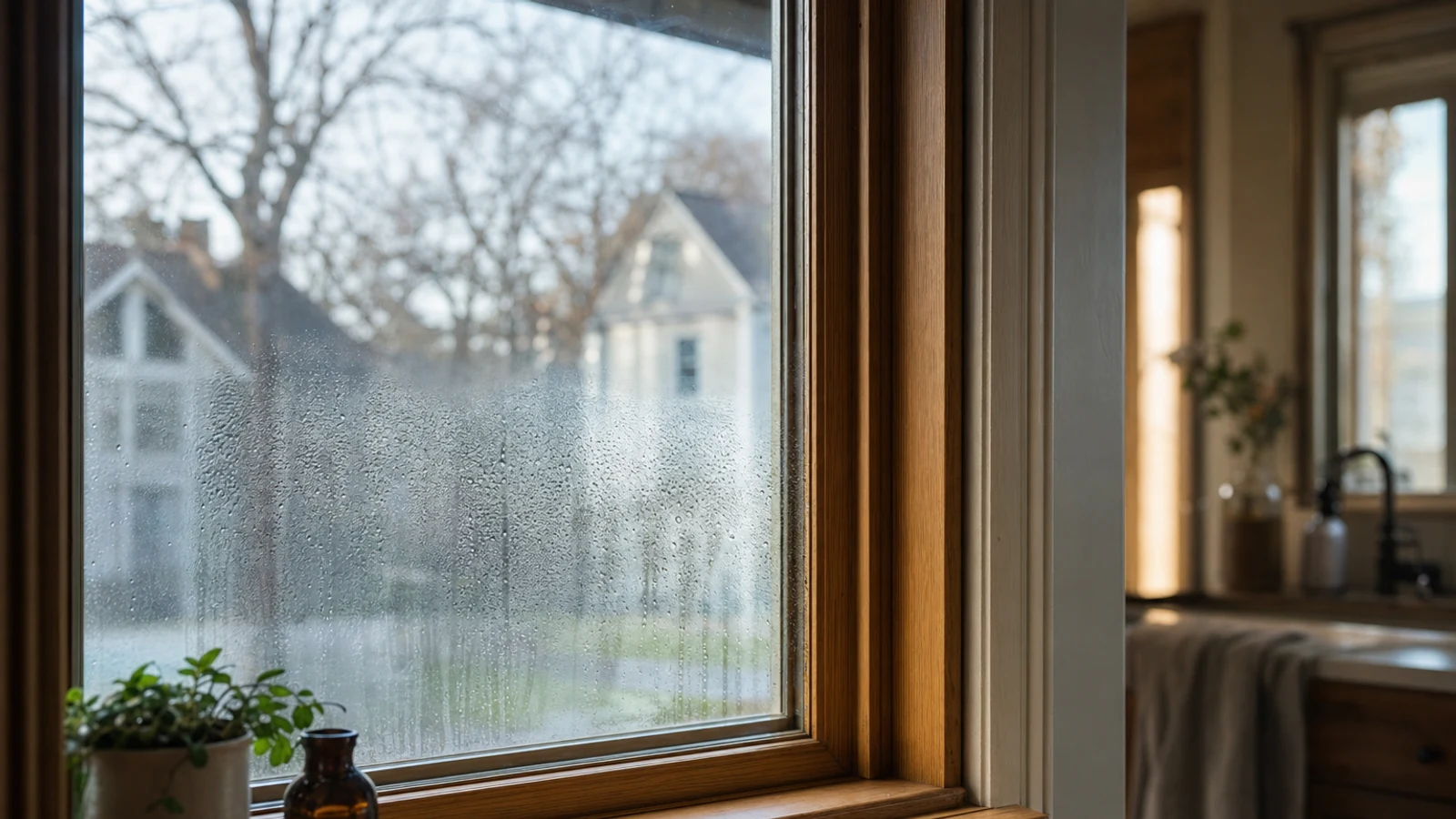
To stop condensation on windows, first determine whether the moisture is on the room side, outside, or between the panes. For interior condensation, measure indoor relative humidity, use kitchen and bathroom exhaust fans, vent moisture-producing appliances outdoors, keep air moving across the glass, and reduce indoor moisture sources. Aim for roughly 30% to 50% indoor relative humidity when practical, while keeping it below 60%. Exterior condensation is often harmless. Condensation trapped between panes usually means the insulated-glass seal has failed and may require a replacement glass unit or sash rather than a whole new window.
Start By Finding Where The Moisture Is
The most important diagnostic step is also the simplest: identify which surface is wet. Condensation can appear on the room-facing glass, the exterior glass, or inside the sealed space between panes. Those three locations can look similar from across a room, but they point to different causes and different levels of urgency.
Wipe both reachable sides of the glass with a dry cloth. If the haze or droplets disappear, the moisture was on that surface. If a cloudy patch remains where neither cloth nor cleaner can reach, it is likely inside the insulated-glass unit. Also note the weather, the room, the time of day, and whether the problem is limited to one window or appears throughout the home.
- Room-side moisture: usually indoor humidity meeting a cold window surface.
- Exterior moisture: often outdoor dew or humidity on glass that has cooled overnight.
- Between-pane moisture: commonly a failed seal in a double- or triple-pane insulated-glass unit.
What Interior Window Condensation Usually Means
Interior condensation forms when humid indoor air reaches a window surface that is colder than the air’s dew point. Glass is often one of the coldest surfaces in a room, so it may show the problem before walls, trim, or other parts of the building envelope do.
In winter, the indoor air is warm relative to the glass. Showering, cooking, drying laundry, using a humidifier, boiling water, and simply breathing can add enough moisture to make the glass wet. A cool bedroom with the door closed may be especially prone to morning condensation because people add moisture overnight while air movement is limited.
High humidity is not always the only factor. A drafty or poorly insulated window can have a colder interior surface than a modern insulated window, making condensation possible even when the room’s humidity does not seem extreme. Curtains, blinds, furniture, or objects pressed close to the glass can also restrict warm room air from reaching the window.
- Check whether condensation is concentrated on older, single-pane, metal-frame, or visibly drafty windows.
- Look for moisture on the lower edge, sill, frame, and nearby wall—not just the center of the glass.
- Treat repeated wetness as a moisture-control problem, not merely a cleaning chore.
Measure Indoor Humidity Before Buying Anything
A small hygrometer can tell you whether the air is actually humid enough to cause the problem. Place it near the center of the room, away from a window, exterior door, kitchen, bathroom, humidifier, radiator, or supply vent. Take readings at different times, including after cooking, after showers, and in the morning when condensation is worst.
The EPA generally recommends keeping indoor relative humidity below 60%, ideally between 30% and 50% when practical. The lower end may be necessary during very cold weather because cold glass can reach the dew point even at moderate indoor humidity. However, driving humidity extremely low is not automatically better; it can worsen dry skin, irritated airways, static electricity, and discomfort.
Use the reading as evidence rather than relying on a single universal target. A home in a mild climate may tolerate a higher winter humidity than a home experiencing very cold outdoor temperatures. If the hygrometer shows ordinary humidity but one window is repeatedly soaked, the window’s temperature, airflow, installation, or condition deserves closer attention.
- Measure before purchasing a dehumidifier or replacing windows.
- Compare readings in affected and unaffected rooms.
- Record outdoor temperature and indoor humidity when the problem occurs.
Reduce Moisture At The Source
The most effective fix is often to stop adding unnecessary moisture to the indoor air. Use the bathroom exhaust fan during showers and leave it running afterward long enough to remove lingering humid air. Kitchen exhaust should vent outdoors, not merely recirculate steam and cooking odors into the room.
Make sure a clothes dryer vents outdoors and that the duct is not disconnected, crushed, or blocked. Avoid unvented combustion appliances indoors because they can add water vapor as well as other indoor-air concerns. Cover boiling pots, use lids when cooking, and avoid drying wet laundry indoors when possible.
Humidifiers deserve special attention. If a humidifier is running while windows are already wet, turn it down or off until the cause is understood. Houseplants, damp basements, crawl spaces, plumbing leaks, and wet building materials can also contribute. Condensation may be the visible clue to a larger moisture source.
- Run bathroom and kitchen exhaust fans during moisture-producing activities.
- Verify that dryers and exhaust fans discharge outdoors.
- Inspect for leaks, damp basements, wet crawl spaces, and unvented appliances.
- Pause or reduce humidifier use if indoor humidity is already elevated.
- Dry wet surfaces promptly instead of allowing water to sit on sills and trim.
Improve Airflow Across The Glass
Warm room air needs a path to move across the window. Keep curtains and blinds open enough for air to circulate, particularly overnight. Move furniture, storage bins, and other objects away from the glass and sill. If a radiator or supply vent is below the window, make sure it is not blocked.
A ceiling fan or small room fan can help distribute warm air, but airflow alone cannot remove moisture from the home. It may reduce condensation on one window by warming the glass surface while leaving the underlying humidity unchanged. Combine air movement with source control and ventilation.
Do not permanently seal a room by closing every vent or blocking every air path in an effort to keep it warmer. A warmer room with trapped moisture can still produce condensation, and poorly ventilated rooms can develop moisture problems in less visible locations.
- Keep window coverings from pressing tightly against cold glass.
- Leave interior doors open when appropriate to improve air mixing.
- Use fans to move air, not as a substitute for exhausting humid air.
Use Ventilation And Dehumidification Carefully
Ventilation works by replacing moisture-laden indoor air with drier outdoor air, but whether opening a window helps depends on the weather. In cold weather, brief ventilation can remove warm, moist indoor air and bring in colder, drier air. In hot or humid weather, opening windows may add moisture; air conditioning or a dehumidifier may be more effective.
A portable dehumidifier can help when indoor humidity remains high, especially in basements, laundry areas, or rooms without effective exhaust ventilation. Choose its location based on the moisture source and keep the air intake and exhaust unobstructed. Empty or drain the unit as directed and clean it according to the manufacturer’s maintenance instructions.
An air purifier is not a substitute for dehumidification. It may filter particles, but it does not generally remove water vapor from the air. Likewise, a fan can move humid air without lowering its moisture content. If the whole home stays humid, the problem may require HVAC evaluation, improved exhaust ventilation, or a whole-house moisture-control strategy rather than another portable appliance.
- Ventilate when outdoor air is colder and drier, if outdoor air quality and weather permit.
- Use air conditioning or dehumidification during humid weather.
- Do not assume an air purifier will solve condensation.
- Address persistent whole-home humidity with an HVAC or ventilation assessment.
Understand Exterior Condensation
Condensation on the outside of a window is often normal and may indicate that the glass is well insulated. Overnight, the exterior surface can cool below the outdoor dew point. In warm, humid weather, indoor air conditioning can also make the exterior pane colder than the surrounding outdoor air, allowing dew to form.
Exterior condensation is usually not a reason to lower indoor humidity or replace the window. It becomes more relevant if water is entering the wall, collecting in a damaged frame, blocking visibility where safety is affected, or appearing alongside failed drainage and sealant. Inspect the frame and surrounding wall for signs of leaks rather than treating every exterior droplet as a window defect.
Do not confuse exterior condensation with water intrusion. Rainwater that appears at the frame, runs down the interior wall, or returns regardless of humidity may point to damaged flashing, failed sealant, clogged drainage paths, or an installation problem.
- Exterior dew is often harmless, especially on efficient windows.
- Check for actual leaks at the frame, trim, sill, and surrounding wall.
- Investigate water that appears during rain or persists independently of weather.
Recognize Condensation Between The Panes
Moisture trapped between the panes cannot be wiped away from either side. In an insulated-glass unit, persistent fogging or droplets in the sealed space commonly indicate that the perimeter seal has failed and outside moisture has entered the cavity.
A failed seal does not automatically mean the entire window opening must be replaced. Depending on the window design, age, condition, and availability of replacement parts, a glass unit, sash, or other component may be replaceable. Ask for an assessment that distinguishes glass-unit repair from full-frame replacement.
Do not drill holes into the glass, inject chemicals, or rely on repeated cleaning attempts. Those approaches may damage the unit or conceal the condition without restoring the original seal. If the window is difficult to reach, part of a high story, cracked, or otherwise unsafe to inspect, use a qualified professional.
- If the haze remains after cleaning both accessible surfaces, suspect moisture between panes.
- Check whether the window is still under a manufacturer, installer, or builder obligation before authorizing work.
- Compare repair of the glass unit or sash with full replacement based on the surrounding frame’s condition.
When The Window Itself Is The Problem
A window may be contributing to condensation when it is unusually cold, visibly damaged, poorly installed, or exposed to strong drafts. Single-pane glass, conductive metal frames, missing insulation around the rough opening, and restricted airflow can all lower the interior surface temperature.
Replacement windows can reduce condensation risk by keeping the interior glass warmer, but they cannot override excessive indoor humidity. Even high-performance windows can collect moisture in cold weather if indoor relative humidity is high enough. Replacing windows before measuring humidity and checking ventilation can therefore be an expensive way to treat the symptom.
If one window is affected while similar windows in the same room remain dry, inspect that opening for drafts, damaged weatherstripping, failed glazing, missing trim insulation, or an unusually exposed location. If every window is wet, prioritize humidity and ventilation diagnosis.
- One affected window suggests a local temperature, airflow, installation, or condition issue.
- Many affected windows suggest a broader indoor humidity or ventilation issue.
- Consider window replacement only after the moisture source and window condition are both understood.
- When shopping, look beyond appearance and ask about insulation, air leakage, and condensation-resistance performance.
Clean Up The Water And Watch For Damage
Dry visible condensation from the glass, frame, and sill when practical, especially if water is pooling. Repeated wetting can stain finishes, swell wood, damage paint, and create conditions that support mold growth. Drying the surface does not solve the cause, but it limits the time materials remain wet while you investigate.
Do not paint, caulk, or permanently cover wet materials before finding the source. Trapping moisture behind trim, film, or sealant can make concealed damage harder to detect. If you find mold, softened wood, peeling paint, staining that extends beyond the sill, or moisture inside the wall, the problem has moved beyond routine window wiping.
Contact a qualified contractor, building-envelope specialist, window professional, or HVAC technician when the source is unclear, damage is recurring, or the work involves inaccessible areas, electrical components, structural repairs, broken glass, or exterior heights.
- Dry wet surfaces promptly and protect wood sills from standing water.
- Do not cover or seal materials that remain damp.
- Escalate when moisture is inside walls, damaging finishes, or accompanied by visible mold.
Common Mistakes That Waste Time And Money
The most common mistake is buying a product before identifying the moisture location. A dehumidifier cannot repair a failed insulated-glass seal, and replacement windows will not correct steam from an unvented dryer. Start with the wipe test, humidity measurement, and a short inspection of ventilation and leaks.
Another mistake is chasing a single humidity number without considering outdoor temperature and the window’s condition. A reading that seems moderate may still produce condensation on very cold glass. Conversely, lowering humidity far below a comfortable level may mask a window or building problem rather than solve it.
Finally, do not treat daily wiping as a complete solution. Wiping protects the sill temporarily, but recurring water is evidence that the moisture balance, airflow, surface temperature, or window assembly needs attention.
- Do not buy a dehumidifier without measuring humidity and locating the source.
- Do not replace every window because of moisture that may be on the room side.
- Do not assume exterior dew means the window is defective.
- Do not seal over damp trim, wall finishes, or suspected leaks.
- Do not use a fan or air purifier as a replacement for moisture removal.
A Practical Decision Sequence
Use this sequence before spending money. First, identify the wet surface. Second, measure indoor humidity in the affected room. Third, inspect moisture sources and confirm that exhaust fans and dryers vent outdoors. Fourth, improve airflow and dry the sill. Fifth, reassess during the weather conditions that usually trigger the problem.
If interior condensation improves when humidity falls and ventilation improves, continue with moisture control and maintenance. If humidity is reasonable but one opening remains wet, investigate the window, frame, installation, and airflow. If moisture is trapped between panes, request a glass-unit or sash assessment. If water appears with rain or extends into the wall, seek a building-envelope inspection.
The best purchase may be a simple hygrometer, an appropriately used dehumidifier, or a replacement part—not necessarily a new window. In many homes, the most durable fix is better moisture control rather than a product at all.
- Diagnose the location.
- Measure humidity.
- Control moisture sources.
- Improve airflow and ventilation.
- Reassess before replacing equipment or windows.
- Call a professional when damage, leaks, failed seals, or unsafe access are involved.
Questions & Answers
Practical follow-up questions readers often ask before acting or buying.
What humidity level should I keep to prevent window condensation?
A practical starting range is about 30% to 50% relative humidity, with indoor humidity kept below 60%. In very cold weather, condensation may require a lower setting because the glass surface becomes colder. Use a hygrometer and adjust based on the actual window condition and outdoor temperature.
Why are my windows wet in the morning but dry later?
Overnight, people add moisture through breathing while rooms may be cooler and less ventilated. The glass can fall below the dew point, creating morning condensation that evaporates after heating, sunlight, or daytime airflow increases.
Should I use a dehumidifier for condensation on windows?
Use one when measurements show elevated indoor humidity and ventilation or source control are not enough. A dehumidifier will not fix moisture between window panes, rain leaks, or a damaged window frame.
Is condensation on the outside of new windows a problem?
Usually not. Exterior dew can occur when well-insulated glass keeps the outside pane colder than humid outdoor air. Investigate further if you see water entering the wall, damaged framing, or moisture that appears unrelated to weather.
Can condensation between double-pane windows be cleaned?
Not from the accessible surfaces. If the haze or droplets remain inside the sealed cavity after both sides are cleaned, the insulated-glass seal may have failed. A window professional can determine whether the glass unit or sash can be replaced.
Will window film stop condensation?
Film may change the temperature of the glass or reduce drafts in some situations, but it does not remove moisture from indoor air or repair a failed seal. Diagnose humidity, ventilation, and the window condition first.
When should I call a professional?
Seek professional help for moisture inside walls, recurring leaks, softened or rotting trim, extensive mold, failed window seals, broken glass, inaccessible windows, structural concerns, or any repair involving unsafe heights or electrical components.
Sources & Further Reading
How to Deal with Window Condensation | Pella