
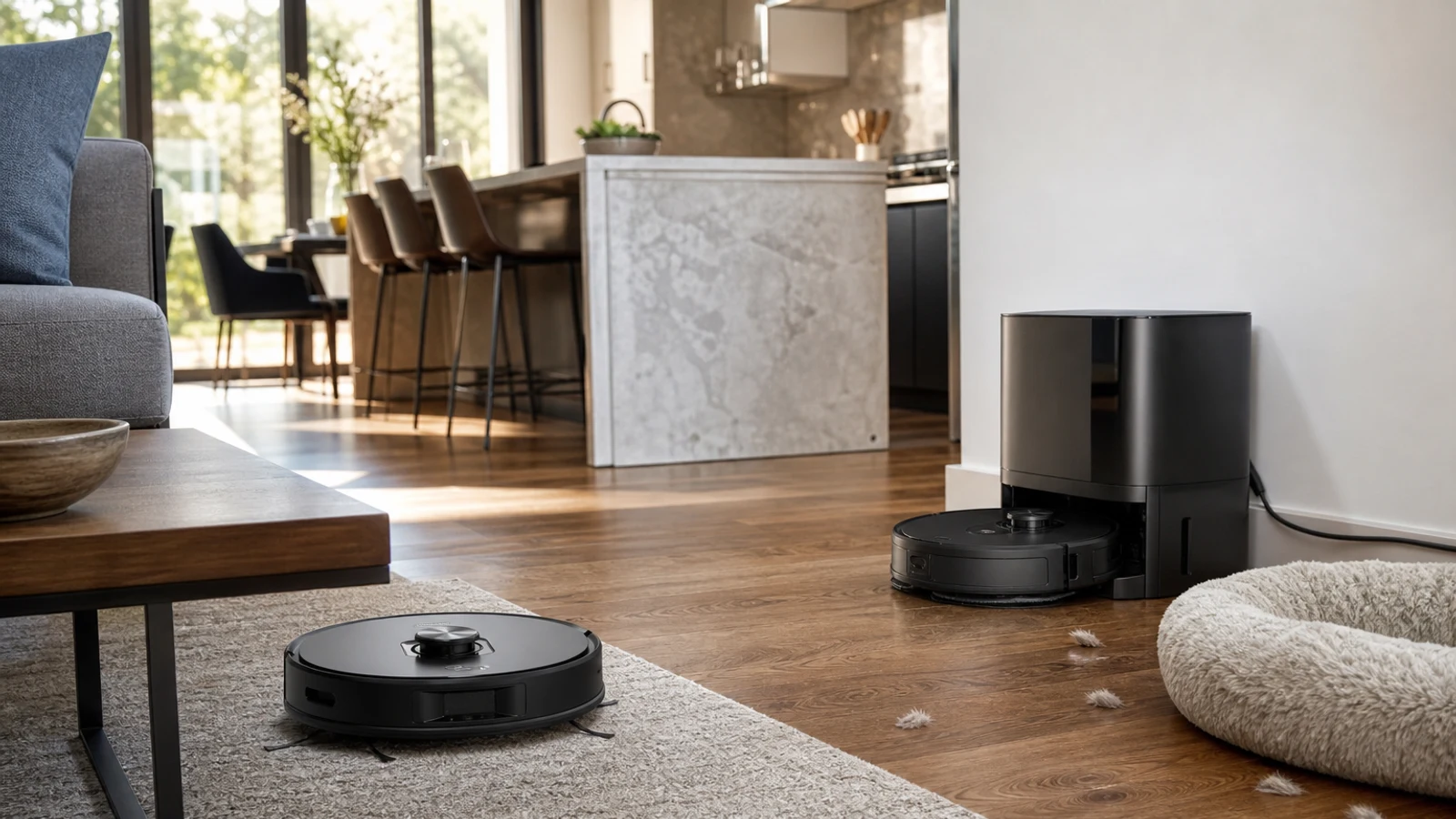
Choose Roborock if you want the broadest selection of feature-rich robot vacuums, sophisticated mapping, stronger mopping automation, and more granular cleaning controls. Choose iRobot if dependable room-based routines, obstacle recognition, familiar app workflows, and Roomba’s established ecosystem matter more than having the widest range of premium features. At the flagship level, compare specific models rather than assuming every Roborock or Roomba performs alike.
At A Glance
| Decision Point | Roborock | iRobot Roomba |
|---|---|---|
| Best For | Advanced features, mopping, and granular control | Guided routines, object recognition, and familiar workflows |
| Navigation | Detailed mapping with strong premium-model sensing | LiDAR and AI object recognition on newer models |
| Mopping | Broad range of rotating-pad and multifunction-dock systems | Newer Max and Plus models use heated roller-mop systems |
| App Controls | More room-level tuning and custom cleaning options | Simpler routines, room targeting, and scheduling |
| Pet Hair | Strong anti-tangle options across premium models | Current models add anti-tangle brush and carpet-focused features |
| Hands-Free Dock | Often includes emptying, washing, drying, and water management | Current AutoWash docks empty debris and wash and dry roller mops |
| Main Trade-Off | More complexity and model-by-model feature variation | Less ecosystem breadth and potentially high premium pricing |
The Short Version
Roborock and iRobot take different approaches to robot vacuum ownership. Roborock emphasizes rapid hardware innovation, detailed mapping, advanced mopping, anti-tangle systems, and multifunction docks. Newer iRobot Roomba models have moved toward similar hands-free features while retaining a focus on guided routines, object recognition, carpet protection, and a familiar app experience.
For most shoppers buying a premium vacuum-and-mop, Roborock is the more feature-rich ecosystem. iRobot can be the safer fit when avoiding scattered objects, targeting rooms, and using simple routines matter more than maximum automation. Brand-level comparisons can hide major differences, so compare the exact robot and dock configuration.
- Best overall ecosystem for advanced features: Roborock
- Best fit for simple room-based routines: iRobot Roomba
- Best for automated mopping: Usually Roborock, depending on the model
- Best for clutter and object recognition: High-end iRobot and Roborock models both deserve consideration
- Best value: Model-dependent; do not compare only by brand name
Roborock Vs iRobot: Key Differences
Roborock’s current premium lineup includes models such as the Saros 10R and Qrevo family. The Saros 10R combines a slim body with StarSight navigation, obstacle recognition, extendable cleaning components, anti-tangle hardware, a liftable chassis, and a multifunction dock. These features target common problems such as getting stuck, missing edges, tangling in hair, and frequent hands-on cleanup.
iRobot’s current range includes Roomba Plus and Max Combo models. The Roomba Max 875 Combo, introduced in September 2026, adds ClearView Pro LiDAR, PrecisionVision object recognition, a heated roller-mop system, carpet protection through DriLift technology, edge cleaning, anti-tangle features, and an AutoWash dock. This is a substantial shift from older, primarily vacuum-focused Roomba models.
Roborock generally gives you more ways to tune cleaning behavior. iRobot’s newer models are closing the hardware gap, but the experience remains more centered on routines, room targeting, and automatic adaptation.
- Roborock generally offers more model variety and configuration flexibility.
- iRobot’s current premium models are substantially more capable than older Roomba generations.
- Dock features vary dramatically, so check whether the package washes, dries, empties, and refills.
- Obstacle avoidance depends on the exact sensors and software, not just the brand.
Navigation And Obstacle Avoidance
Roborock is attractive to shoppers who want fast, structured mapping and precise room control. Premium models use advanced laser-based and 3D sensing systems to build maps, identify obstacles, and plan routes. The app typically supports room divisions, no-go zones, cleaning order, room-specific settings, and combined vacuuming and mopping.
iRobot has a strong history of object recognition, particularly in Roomba models designed to identify cords, shoes, toys, and pet waste. Newer models combine LiDAR with camera- or AI-based recognition, while their mapping tools support room targeting, zones, schedules, and multiple maps on compatible models.
If floors are mostly clear and detailed control matters, Roborock is often the easier fit. If toys, cables, pet accessories, or other clutter are common, choose a model with the strongest documented object-recognition system.
- For open floor plans and detailed map control, Roborock is often the easier fit.
- For homes with frequent clutter, prioritize a model with advanced object recognition.
- No robot can reliably avoid every small cable, sock, or pet-waste incident.
- Threshold height, furniture clearance, and dock placement also matter.
Vacuuming And Pet Hair
Both brands offer anti-tangle strategies, but designs differ by model. Roborock uses systems such as split main brushes, anti-tangle side brushes, and high suction settings on premium products. iRobot’s current premium Roomba models use dual anti-tangle features intended to move hair into the suction path and prevent buildup.
For thick carpet, consider brush contact, carpet-boost behavior, repeated-pass settings, edge cleaning, and whether the robot can recharge and resume. Published suction numbers are not directly comparable across brands, so they are not a complete prediction of cleaning performance.
If pet hair is the main problem, choose by brush design, hair handling, carpet behavior, obstacle avoidance, and replacement-part availability. Even a strong robot will not replace occasional manual cleaning of stairs, upholstery, and corners.
- Roborock is often stronger for extensive automation and hair-resistant hardware.
- Newer Roomba models have improved anti-tangle designs and carpet-focused features.
- Expect to clean sensors, brushes, filters, and dock components even with self-emptying models.
Mopping And Dock Automation
Roborock has usually held the clearest advantage in mopping. Many Qrevo and Saros models use rotating mop pads or advanced mop systems, automatically lift or remove mops, wash and dry them, refill the robot, and empty dirty water. These features suit homes with large hard-floor areas and frequent kitchen or entryway messes.
iRobot now competes more directly with roller-based mopping. The Roomba Max 875 Combo uses heated mist and a self-cleaning roller mop, while its AutoWash dock washes and dries the roller, empties debris, and refills the robot. This differs from a simple damp pad and may appeal to buyers seeking more active scrubbing.
Neither ecosystem eliminates maintenance. Water tanks, docks, consumables, mop systems, and dirty-water reservoirs still require attention. Multifunction docks also need more floor space.
- Roborock offers more mature variety in multifunction mopping docks.
- iRobot’s newest roller-mop systems improve on basic pad mopping.
- Mop washing and drying reduce work but do not eliminate maintenance.
- Check dock dimensions, water-tank access, cleaning-solution rules, and replacement-part costs.
Apps, Smart-Home Features, And Ecosystem Fit
Roborock’s app suits shoppers who like control. Depending on the model, you can adjust suction and water flow by room, set cleaning sequences, define no-go zones, manage multiple maps, and create detailed routines. That flexibility helps in mixed-floor homes but can make setup more complicated.
The iRobot Home app is generally more approachable for routine-driven cleaning. Compatible Roombas can save maps, target rooms and zones, schedule cleanings, create recurring routines, and work with voice assistants. Features vary by model, and older Roombas may have fewer mapping and automation capabilities.
Both brands support voice control on compatible products, but smart-home compatibility must be verified for the exact model. Matter support, platform integrations, and app features can differ across generations. Also confirm that proprietary bags, filters, brushes, mop parts, cleaning solutions, and software support suit your long-term plans.
- Roborock is better for granular settings and advanced cleaning plans.
- iRobot is better for guided routines and a less technical setup.
- Verify Apple, Google, Alexa, and Matter support by model.
- Factor in consumables, app dependence, dock space, and replacement-part access.
Who Should Buy Roborock
Roborock is the better fit for shoppers who want one machine to vacuum and mop much of the home with minimal intervention. It is especially appealing for mostly hard-floor homes, room-by-room control, and buyers comfortable configuring maps and routines.
Choose Roborock when edge cleaning, mop washing, drying, water management, anti-tangle hardware, and detailed automation are priorities. Reconsider it if you want the simplest setup, dislike managing water tanks and dock components, or are considering a model without advanced object recognition for a cluttered home.
- Buy Roborock for advanced mopping and hands-free dock automation.
- Buy it for detailed map editing and room-specific cleaning controls.
- Skip lower-feature models if cords, toys, or pet accidents are common.
- Budget for proprietary consumables and periodic dock cleaning.
Who Should Buy iRobot Roomba
iRobot suits shoppers who value a familiar, routine-focused experience and want a current Roomba with strong object recognition. It can make sense when vacuuming is the main task, room-based schedules matter more than numerous manual settings, or the household already uses compatible Roomba products.
The newest Roomba Max and Plus models deserve closer consideration than older comparisons suggest. Their LiDAR mapping, AI object recognition, heated roller mopping, carpet protection, and AutoWash docks bring iRobot closer to feature-heavy competitors.
Reconsider iRobot if you want the broadest selection of advanced dock configurations or the most detailed room-by-room control. Compare pricing carefully, since a premium Roomba can cost as much as or more than a feature-rich Roborock.
- Buy iRobot for guided routines and a mature room-cleaning workflow.
- Buy a current premium model if object recognition and clutter avoidance are priorities.
- Skip older Roombas if you want modern self-washing mops or advanced dock automation.
- Do not assume all Roomba models share the same features.
The Better Choice For Different Homes
For a large, mostly hard-floor home, Roborock usually has the stronger fit because its ecosystem offers more advanced mopping and dock automation. For frequent toys, cables, and pet-related clutter, compare high-quality obstacle-avoidance models from both brands and prioritize documented recognition features.
For mostly carpeted homes, vacuum performance, brush design, edge cleaning, and carpet boost deserve more weight than mop technology. A vacuum-focused robot may be better than paying for a complex mop dock that will rarely be used.
For a small apartment, dock size and noise may matter more than flagship features. For multi-level homes, verify map support and whether you will need to carry the robot between floors. The best ecosystem is the one whose maintenance and controls match your habits.
- Large hard-floor home: Roborock is usually the stronger starting point.
- Cluttered pet home: Compare premium obstacle-avoidance models from both brands.
- Mostly carpet: Prioritize brush design, carpet cleaning, and hair handling.
- Small apartment: Consider robot height, dock footprint, noise, and storage.
- Multi-level home: Verify map support and whether the dock must remain on one floor.
Final Verdict
Roborock is the better default recommendation for shoppers seeking the most capable robot vacuum ecosystem. Its current products generally offer more sophisticated mopping, detailed controls, and hands-free dock features, especially for homes with substantial hard flooring.
iRobot remains a credible alternative, particularly with current Roomba Max and Plus models. Newer hardware addresses weaknesses associated with older Roombas, while the app and routine system remain attractive to buyers who want guided, room-focused cleaning. It may be the better match when object recognition and clutter avoidance matter more than maximum flexibility.
Make the final decision between two exact packages, not two logos. Compare sensors, brush systems, mop design, dock functions, clearance, threshold ability, app features, consumables, and support documentation. If both fit your floor plan, Roborock usually wins on features; if you value simpler routines and a familiar ecosystem, iRobot can be the smarter purchase.
- Best overall recommendation for feature seekers: Roborock.
- Best alternative for routine-focused buyers: iRobot Roomba.
- Do not compare suction numbers alone.
- The dock, app, replacement parts, and obstacle avoidance can matter more than headline specifications.
Questions & Answers
Practical follow-up questions readers often ask before acting or buying.
Is Roborock better than iRobot Roomba?
Roborock is generally better for advanced mopping, detailed app controls, and multifunction dock automation. iRobot can be better for buyers who prefer simple room-based routines, a familiar app, and strong object recognition on compatible current models. The exact model matters more than the brand alone.
Which is better for pet hair, Roborock or iRobot?
Both brands offer models with anti-tangle brush systems and pet-focused features. Roborock often provides more automation and detailed cleaning controls, while newer Roomba models emphasize anti-tangle designs, carpet cleaning, and object recognition. Choose by exact brush design, carpet performance, obstacle avoidance, and replacement-part availability.
Does Roborock mop better than Roomba?
Roborock has traditionally offered a broader selection of advanced mopping systems and self-cleaning docks. iRobot’s current Roomba Max and Plus models improve the comparison with heated roller mops and AutoWash docks. For mostly hard floors, compare the specific mop and dock systems rather than older brand reputations.
Which brand has the better robot vacuum app?
Roborock is usually better for granular settings, map editing, room-specific suction and water adjustments, and custom cleaning sequences. iRobot’s app is often easier for guided schedules, room targeting, and repeatable routines. The better app depends on whether you prefer control or simplicity.
Are Roborock and Roomba good for homes with clutter?
Premium models from both brands can recognize and avoid more objects than basic robots, but no robot reliably avoids every cable, sock, toy, or pet-waste incident. If clutter is common, prioritize advanced obstacle recognition, review the exact model’s documented capabilities, and still clear high-risk items before scheduled cleaning.
Should I buy a robot vacuum with a self-cleaning dock?
A self-emptying or multifunction dock is worthwhile if you want less daily involvement and have enough space for the station. It does not eliminate maintenance: water tanks, dirty-water reservoirs, brushes, filters, mop components, and dock trays still need periodic cleaning and replacement.
Sources & Further Reading
App Robot Vacuums | Roborock US Official Store
The 4 Best Roombas And iRobot Vacuums of 2026: Reviews - RTINGS.com