
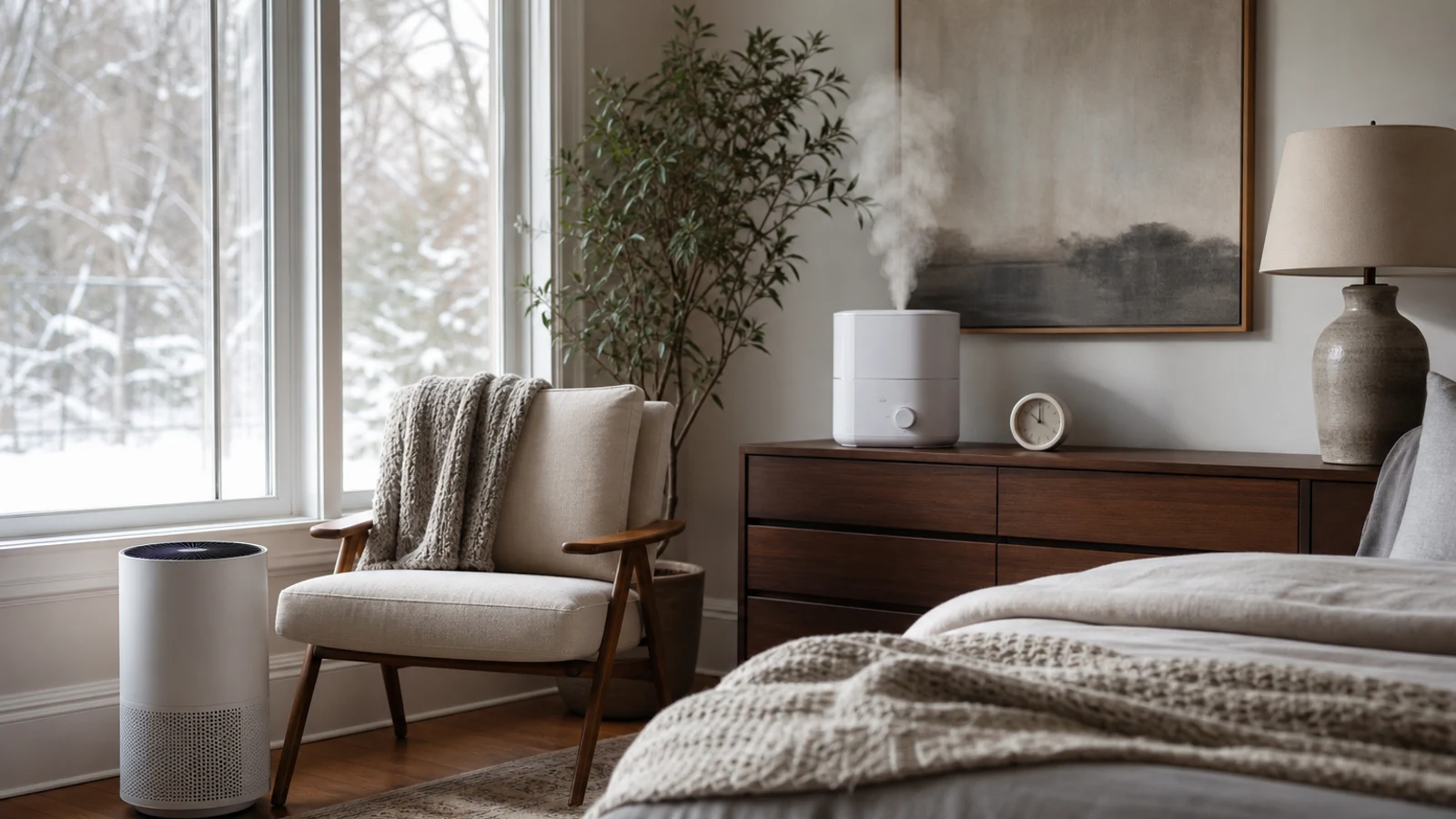
Choose an air purifier for airborne particles such as dust, pollen, pet dander, and some smoke particles. Choose a humidifier only when your indoor humidity is consistently low and you have dry-air discomfort. If humidity is already moderate or you see condensation, mold, or musty smells, do not add a humidifier. Some homes need both, but they should be treated as separate tools with separate maintenance requirements.
At A Glance
| Decision Point | Air Purifier | Humidifier |
|---|---|---|
| Primary job | Captures some airborne particles | Adds moisture to dry air |
| Best for | Dust, pollen, pet dander, and smoke particles | Measured low humidity and dry-air discomfort |
| What it does not fix | Leaks, high humidity, carbon monoxide, or every gas | Dust, pollen, smoke, mold sources, or poor ventilation |
| What to measure | Room size, CADR, airflow, and filter condition | Relative humidity with a hygrometer |
| Main maintenance | Clean prefilters and replace filters | Empty, clean, dry, and refill the water tank |
| Main risk of misuse | Poor performance from undersizing or neglected filters | Condensation, mineral dust, or contaminated mist |
| When not to use it | As a substitute for source control or ventilation | In an already damp or mold-prone room |
The Short Version: They Do Different Jobs
An air purifier pulls room air through filters and sends it back with fewer captured particles. It can be useful for dust, pollen, pet dander, wildfire smoke particles, and other airborne particulate pollution. It does not solve the source of a leak, remove every pollutant, or replace ventilation and cleaning.
A humidifier adds water vapor to dry indoor air. It may make a dry nose, throat, lips, skin, or static-prone room feel more comfortable, but it does not clean dust, pollen, smoke, or pet allergens from the air. Adding moisture to a room that is already damp can create a different problem: condensation, mineral deposits, or conditions that support mold growth.
Before buying either device, measure the room and identify the problem. The EPA generally recommends keeping indoor relative humidity between 30% and 50%, while avoiding levels above 60%. A small hygrometer is often more useful than guessing from symptoms alone.
- Air purifier: removes or captures some airborne particles.
- Humidifier: increases relative humidity.
- Neither device fixes a roof leak, plumbing leak, poor ventilation, or visible mold.
- A fan, air conditioner, or dehumidifier may be the better answer for heat or excess moisture.
Choose An Air Purifier When Particles Are The Problem
An air purifier is the more relevant choice when your concern is what is floating in the room. Typical examples include recurring dust, seasonal pollen, pet dander, smoke that enters from outdoors, or fine particles created by cooking and combustion. It can also be useful in a bedroom or living area where you want supplemental filtration after addressing sources and ventilation.
For shopping, focus on the amount of air the unit can move and clean, not just the word “HEPA” on the box. Look for a credible clean air delivery rate, or CADR, and compare it with the room where the unit will actually run. A purifier that is quiet enough to operate consistently may be more useful than a theoretically powerful unit that is rarely turned on.
A purifier is not a universal air-quality machine. Standard particle filters do not automatically remove carbon monoxide, radon, excess humidity, or every odor-producing gas. Activated carbon can help with some gases and odors, but its usefulness depends on the amount and quality of carbon and the pollutant involved. Source control and ventilation remain the first steps recommended by the EPA.
Avoid treating an air purifier as a cure for a visible mold problem. If you see or smell mold, the moisture source and the affected materials need attention. Filtration may reduce some airborne particles while the unit runs, but it does not remove mold growing on walls, carpets, insulation, or furnishings.
- Best match: dust, pollen, pet dander, smoke particles, and some airborne debris.
- Check: CADR, room coverage method, replacement-filter cost, noise, and operating controls.
- Prefer a unit that does not intentionally emit ozone.
- Do not expect it to remove carbon monoxide, correct humidity, or fix a pollutant source.
Choose A Humidifier Only When Humidity Is Actually Low
A humidifier makes sense when a hygrometer shows that a room is persistently dry, particularly during heating season or in a dry climate. Low humidity can contribute to uncomfortable dry-air symptoms and static. A cool-mist humidifier may make a stuffy nose feel more comfortable, but symptom relief is not the same as treating the underlying illness or allergy.
Use a humidifier by measurement rather than by habit. If the room is already near the recommended humidity range, running one can push the space toward condensation. Moisture on windows, damp walls, a musty smell, or a room that feels clammy are reasons to stop humidifying and investigate instead.
The device type also affects upkeep. Evaporative models use a fan and wet wick, while ultrasonic models create a fine mist from water. Steam models heat water but still require cleaning and safe placement. Depending on the water quality and design, some units can leave mineral residue or release mineral-containing particles. Follow the manufacturer’s water guidance; distilled or demineralized water may be recommended, especially where tap water is hard.
Humidifiers are maintenance-heavy compared with many people expect. Empty standing water regularly, clean the unit according to its instructions, let parts dry, and replace wicks or filters when required. The CDC advises emptying portable humidifiers daily and cleaning them regularly. A neglected humidifier can spread contaminants through its mist rather than improving the room.
- Best match: measured, persistent low humidity and dry-air discomfort.
- Use a hygrometer or built-in humidistat instead of relying on feel alone.
- Stop if you see condensation or humidity rises too high.
- Daily water changes and regular cleaning are part of the ownership cost.
When You Might Need Both
Some rooms have two separate problems: airborne particles and low humidity. For example, a bedroom may be dry during winter while also containing pet dander or outdoor particles. In that situation, a purifier and humidifier can perform complementary jobs, but neither substitutes for the other.
If you use both, keep the humidifier’s mist away from the purifier intake and controls. Excess moisture reaching a particle filter can shorten filter life or create damp surfaces. Give each device enough clearance for airflow, and monitor humidity in the room rather than assuming that a setting on one appliance represents the whole space.
A combination unit can save floor space, but convenience may come with trade-offs. A two-in-one appliance can be harder to clean, and a problem with one function may affect the usefulness of the other. Separate units make it easier to place, maintain, replace, or stop one function without losing the other. The better choice depends on available space, noise tolerance, cleaning discipline, and whether both functions are needed throughout the year.
Do not buy both automatically because a room feels uncomfortable. Heat may call for air movement or cooling, a musty basement may need moisture control, and a persistent odor may require source removal. The most useful first purchase may be a hygrometer rather than either appliance.
- Use both only when you have evidence of both low humidity and airborne-particle concerns.
- Keep humidifier mist away from the purifier and nearby furniture.
- Separate units are easier to troubleshoot and maintain.
- A combination unit is not automatically the most effective or economical choice.
A Practical Room-by-Room Decision Process
Start with the room’s measured relative humidity at different times of day. Check after heating or air conditioning has been running, after showering or cooking, and when the room feels uncomfortable. One reading can miss large swings.
Next, identify the specific complaint. Dust settling on surfaces, pollen entering through windows, pet dander, and smoke point toward filtration. Dry skin or a scratchy throat paired with low humidity points toward humidification. Condensation, musty odors, damp materials, and visible mold point away from a humidifier and toward moisture control.
Then address the source before adding equipment. Use kitchen and bathroom exhaust fans, repair plumbing or roof leaks, keep damp materials dry, vacuum and dust, improve ventilation when outdoor conditions permit, and avoid indoor smoking. The EPA describes source control and ventilation as primary indoor-air-quality strategies, with filtration as a supplement.
Finally, estimate the ongoing work. An air purifier needs filter monitoring and replacement. A humidifier needs water handling, frequent cleaning, descaling, and safe storage. If you know you will not perform the maintenance, the device may create more problems than it solves.
- Measure humidity before buying a humidifier.
- Match the appliance to one room or area, not an entire home unless it is designed for that purpose.
- Calculate recurring filter, wick, water, and cleaning-supply needs.
- Choose controls you will realistically use every day.
Common Mistakes To Avoid
The most common mistake is assuming that every indoor-air complaint is the same. A purifier does not humidify, and a humidifier does not filter. Buying the wrong appliance can leave the original problem untouched while adding noise, maintenance, or operating cost.
Another mistake is over-humidifying. More moisture is not automatically better. Condensation on windows or walls is a warning sign, and persistent high humidity can encourage mold and other biological growth. If the room is damp, investigate leaks and ventilation or consider dehumidification instead.
Do not ignore maintenance because the water looks clean or the filter still appears usable. Standing water, mineral scale, and hidden residue can accumulate inside a humidifier. Similarly, a loaded purifier filter can restrict airflow and reduce performance. Follow the appliance’s instructions rather than using a universal cleaning schedule when the manufacturer specifies something different.
Finally, do not rely on marketing language alone. “Air cleaning,” “natural humidification,” “medical-grade,” and “covers a large room” can mean different things across brands. Look for measurable information, clear maintenance instructions, replacement-part availability, and a return policy that gives you a practical way to assess noise and fit.
- Do not use a humidifier in a damp room just because someone has congestion.
- Do not assume a purifier removes every odor or gas.
- Do not aim humidifier mist at electronics, walls, bedding, or the purifier intake.
- Do not run either appliance indefinitely without checking the room conditions.
When Not To Buy Either One
You may not need an air purifier if your concern is ordinary surface dust that can be reduced through cleaning, better entryway habits, ventilation, and HVAC filtration. You may not need a humidifier if your humidity is already in a comfortable range. A hygrometer and source-control steps can sometimes solve the decision before a larger appliance enters the room.
Do not use an appliance as the main response to carbon monoxide, a suspected gas leak, radon, a serious combustion problem, or a major water intrusion. Those issues require appropriate alarms, testing, repair, or professional help. A purifier cannot make an unsafe combustion source safe.
Professional help is appropriate for extensive or recurring mold, persistent dampness, hidden leaks, major water damage, or breathing symptoms that continue despite reasonable environmental changes. If a child, older adult, or person with asthma or another lung condition is affected, ask a healthcare professional for individualized advice rather than relying on an appliance claim.
- Buy neither until you know whether humidity or particles are the actual problem.
- Use carbon-monoxide alarms and address combustion sources directly.
- Get professional help for extensive mold, recurring leaks, or major water damage.
- Seek medical advice for persistent or severe breathing symptoms.
Questions & Answers
Practical follow-up questions readers often ask before acting or buying.
Can an air purifier replace a humidifier?
No. An air purifier is designed to capture certain airborne pollutants, while a humidifier adds moisture. They address different conditions and cannot perform each other’s primary function.
Can I run an air purifier and humidifier in the same room?
Yes, if the room genuinely needs both. Keep the humidifier’s mist away from the purifier intake, walls, furniture, and electronics, and monitor humidity with a hygrometer.
Which is better for allergies: an air purifier or humidifier?
An air purifier is generally the more relevant tool for airborne particles such as pollen and pet dander. A humidifier may make dry-air discomfort feel better, but excess humidity can worsen moisture-related problems. Measure humidity before using one.
Should I use a humidifier if I have mold?
Usually not. Mold indicates a moisture problem, so adding more moisture may make conditions worse. Fix the water source, dry affected materials, and arrange appropriate cleanup or professional remediation when needed.
What humidity level should I aim for?
A practical target is generally 30% to 50% relative humidity, while avoiding levels above 60%. Use a hygrometer because humidity can change throughout the day and from room to room.
Is a purifier-humidifier combo better than two separate devices?
Not automatically. A combo can save space, but separate devices are often easier to maintain, troubleshoot, and replace independently. Compare cleaning access, filter or wick costs, airflow, noise, and the controls for each function.
Sources & Further Reading
Air Cleaners and Air Filters in the Home | US EPA
Care for Your Air: A Guide to Indoor Air Quality | US EPA
Humidifiers and Indoor Allergies | AAAAI
Air Cleaners, HVAC Filters, and Coronavirus (COVID-19) | US EPA