
For most damp bedrooms, the Midea MAD20S1QWT is the most balanced choice because it combines meaningful moisture removal, a compact Cube design, continuous-drain capability, smart controls, and a larger-than-average tank. Choose the Midea MAD35S1QWT for a larger or persistently damp bedroom, the Danby DDR020BJWDB-ME for straightforward 22-pint operation, the Frigidaire FHDD2234W1 for Wi-Fi control in a compact compressor unit, or the TABYIK DH-CS01 only for closets and very light moisture control.
How We Chose These Bedroom Dehumidifiers
This is a research-based buying guide, not a report of hands-on testing by ProductReviewLab. The recommendations combine current independent testing, current manufacturer specifications, product availability signals, and the practical requirements of bedroom use. A bedroom dehumidifier needs to remove enough moisture to make a noticeable difference without adding excessive noise, heat, maintenance, or trips to the sink.
The most important distinction is between compressor and thermoelectric designs. Compressor models are generally the better fit when a bedroom feels persistently muggy, windows collect condensation, or indoor humidity stays high for long periods. Thermoelectric models can make sense in a closet, bathroom, RV, or very small enclosed space, but their lower extraction capacity makes them a poor substitute for a full-size bedroom unit when moisture is significant.
- Prioritize a built-in humidistat so the unit can cycle instead of running continuously.
- Check the tank size and whether continuous drainage is practical in your room.
- Treat manufacturer coverage claims as estimates, not guarantees; insulation, climate, doors, and moisture sources matter.
- For overnight use, look for credible noise information and avoid assuming that a tiny unit will automatically be quiet enough.
1. Midea MAD20S1QWT — Best Overall For Most Bedrooms
The Midea MAD20S1QWT is the most balanced pick for a typical bedroom or small room where you want real moisture control without jumping to a bulky 35- or 50-pint machine. It is a 20-pint Cube model with a lift-and-twist design, a washable filter, a removable tank, continuous-drain capability, and smart control through the Midea app. The current product listing also identifies a 12-liter bucket, automatic shutoff, automatic defrost, and a published noise figure of 45 dBA.
Its strongest advantage is everyday usability. The Cube can be operated in an extended configuration and nested for storage, which is useful if you only need it during humid seasons. The larger tank design also reduces how often you need to empty it compared with many compact units. Independent testing has identified this model as a strong small-room choice because it offers meaningful moisture removal while remaining more bedroom-friendly than many larger dehumidifiers.
The trade-off is that it is still a compressor appliance. It will not be silent, and it can add some warmth to a small room. The unit also has no built-in pump, so continuous drainage requires a suitable lower drain or sink arrangement. For a bedroom with only occasional condensation, it may be more appliance than you need; for a genuinely muggy bedroom, that extra capacity is useful.
Best for: Most bedrooms, guest rooms, and small rooms with recurring humidity. Skip it if you need a tiny closet unit or a built-in pump for uphill drainage.
- 20-pint capacity with a larger Cube-style tank
- Smartphone and voice-assistant compatibility
- Nested storage design and continuous-drain option
- No built-in pump; compressor noise remains noticeable
2. Midea MAD35S1QWT — Best For Larger Or Persistently Damp Bedrooms
The Midea MAD35S1QWT is the better choice when a bedroom is large, connected to an open area, located in a basement, or consistently damp enough that a smaller unit runs for long stretches. Current independent testing identifies it as a leading bedroom option because of its moisture-removal performance, comparatively quiet operation for its capacity, and relatively low heat output compared with many larger 50-pint models.
The current Midea listing describes a 35-pint capacity, smart control, wheels, a built-in handle, a washable filter, and continuous drainage through an included hose. The Cube design gives it a large tank and lets you nest the unit for storage. Those features matter more than they may sound: a dehumidifier that is difficult to move or constantly needs emptying is less likely to be used consistently.
The limitation is size and weight. This is not a discreet nightstand appliance, and the compressor section makes it cumbersome to lift. It also lacks a built-in drain pump, so the hose needs to run to a lower drain. For a small, lightly humid bedroom, the MAD35S1QWT is likely overkill and may take up more floor space than necessary.
Best for: Large bedrooms, basement bedrooms, and rooms with persistent condensation or high humidity. Skip it if floor space is tight or your room only needs light moisture control.
- Higher capacity without moving to a 50-pint model
- Large tank, wheels, handle, and hose-drain option
- Independent testing supports its bedroom suitability
- Bulky and heavy for a typical small bedroom
Compare options as you read
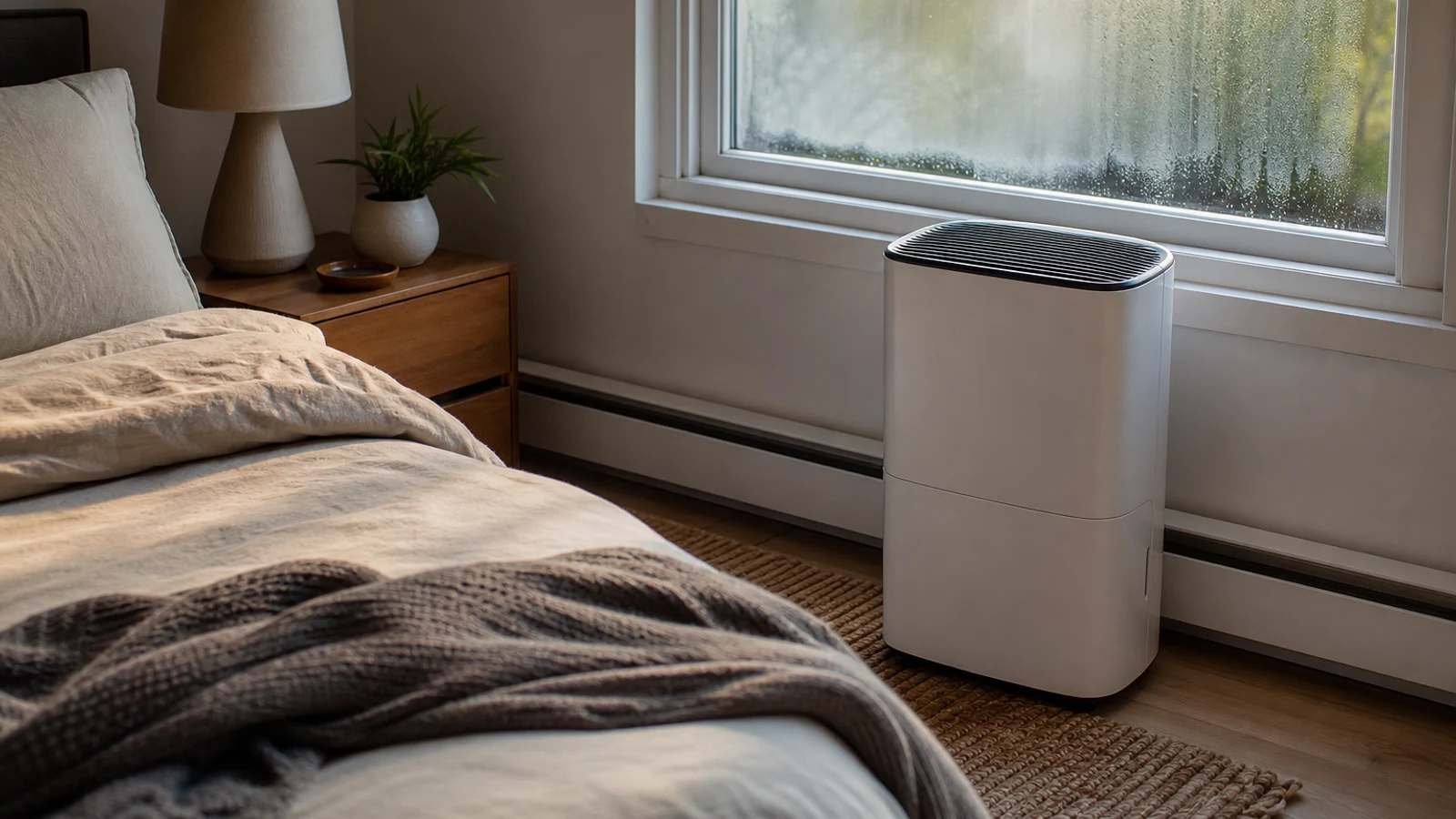
Explore options related to this guide. Check the exact product, seller, specifications and current price on Amazon. Image is illustrative.
As an Amazon Associate I earn from qualifying purchases.
3. Danby DDR020BJWDB-ME — Best Straightforward 22-Pint Option
The Danby DDR020BJWDB-ME is a practical alternative for shoppers who want a conventional portable compressor dehumidifier rather than a Cube-style design. Danby lists it as a 22-pint model for spaces up to 1,500 square feet, with a published product footprint of approximately 15.2 inches wide, 10.94 inches deep, and 19.72 inches high. The capacity is a sensible middle ground for a bedroom that is too damp for a mini unit but does not justify a larger machine.
Its appeal is simplicity. A conventional upright shape can fit more naturally beside a wall or in a corner than a wider, more unusual design. The model is also positioned for room-scale humidity control rather than closet duty, making it a better match for buyers who want one appliance to handle a bedroom, office, or small living area.
The key limitation is that a published room-size number does not tell you how the unit will perform in your specific home. A 1,500-square-foot claim should not be interpreted as a promise that one machine will dry an open floor plan or a heavily damp basement. Buyers should also verify the exact drainage accessories, noise information, and current retailer stock before purchasing because model variants can differ.
Best for: Buyers who prefer a conventional 22-pint design and straightforward room humidity control. Skip it if app control, an unusually large tank, or independently measured bedroom performance is your top priority.
- 22-pint capacity suited to small and medium rooms
- Conventional upright footprint
- Useful middle ground between mini and large models
- Verify exact drainage, noise, and availability details for the current listing
4. Frigidaire FHDD2234W1 — Best For Wi-Fi In A Compact Compressor Unit
The Frigidaire FHDD2234W1 is a current 22-pint Energy Star model with Wi-Fi, giving it a useful advantage for shoppers who want to monitor or adjust a dehumidifier without walking across the room. For a bedroom, remote control can be convenient when you want to change settings before sleeping, check whether the unit is running, or manage moisture while away from home.
Its capacity places it in the same practical category as other mid-size bedroom compressor models. That makes it more appropriate for a real bedroom than many desktop-size thermoelectric units, particularly when the problem is recurring humidity rather than a single damp corner. Frigidaire is also a familiar appliance brand with an established support and replacement-parts ecosystem, though buyers should confirm the current warranty and service terms for the exact seller and model.
The main drawback is that the current manufacturer page provides less detailed public information than some competing listings about noise, tank dimensions, and bedroom-specific behavior. Wi-Fi also adds complexity without improving the underlying moisture-removal performance. If you will set the humidity once and leave the controls alone, a simpler unit may offer better value.
Best for: Shoppers who specifically want Wi-Fi control in a compact compressor dehumidifier. Skip it if you do not need smart features or if detailed noise and tank information are essential before buying.
- 22-pint capacity for bedroom-scale use
- Wi-Fi control for remote adjustments and monitoring
- Energy Star certification listed by the manufacturer
- Public specifications are less complete on some bedroom-relevant details
5. TABYIK DH-CS01 — Best For Closets And Very Light Moisture
The TABYIK DH-CS01 earns a place on this list because some shoppers do not need a full bedroom compressor dehumidifier. Independent testing identifies it as a practical option for a bedroom closet, walk-in wardrobe, or other small enclosed space where compact size, low heat, and quiet operation matter more than fast moisture removal.
This type of unit can be appealing beside a bed or in a small storage area because it takes up little room and is less intrusive than a compressor appliance. It may also be easier to carry and position than a full-size model. For light condensation or a modestly damp closet, that simplicity can be enough.
The important limitation is performance. The DH-CS01 should not be treated as an equivalent to a 20- or 35-pint compressor model. If your bedroom regularly feels muggy, humidity remains high overnight, or condensation returns quickly, a tiny unit may run continuously without solving the underlying problem. Its best use case is targeted, light-duty moisture control.
Best for: Closets, tiny rooms, RVs, and very light moisture. Skip it for a damp primary bedroom, basement bedroom, or recurring condensation problem.
- Very compact and easy to place
- Low-heat design suited to enclosed spaces
- Better for light moisture than whole-room dehumidification
- Not a substitute for a compressor model in a persistently damp bedroom
What Size Dehumidifier Does A Bedroom Need?
Room size matters, but it is only one part of the decision. A small bedroom in a humid climate may need more capacity than a larger room in a dry climate. Basement bedrooms, rooms with exterior-wall condensation, and bedrooms connected to bathrooms or laundry areas also tend to need more moisture-removal capacity.
As a practical starting point, a 20- to 22-pint compressor model is the most versatile category for many bedrooms and small rooms. Move up to a 35-pint model when the room is larger, the humidity is persistent, or the unit would otherwise run almost continuously. Use a tiny thermoelectric unit only when the moisture problem is genuinely light and localized.
A dehumidifier is also not a repair for leaks, plumbing failures, roof problems, or inadequate bathroom ventilation. If humidity returns immediately after the unit cycles off, inspect the moisture source rather than simply buying a larger appliance. Persistent musty odors, visible mold, water intrusion, or damage behind walls may require a qualified professional.
- Use a hygrometer to understand the actual humidity before choosing capacity.
- Leave clearance around the air intake and exhaust; do not push the unit tightly against bedding or curtains.
- Consider continuous drainage if you cannot reliably empty the tank.
- Clean the filter according to the manual and keep the bucket area dry.
Our Verdict
The Midea MAD20S1QWT is the best starting point for most shoppers because it balances capacity, compactness, tank convenience, drainage flexibility, and smart controls. The Midea MAD35S1QWT is the stronger choice when the room is larger or noticeably damp. The Danby and Frigidaire options make sense for buyers who prefer conventional 22-pint designs, with the Frigidaire adding Wi-Fi control. The TABYIK DH-CS01 is useful only when the space and moisture problem are genuinely small.
The biggest buying mistake is choosing a mini dehumidifier because it looks bedroom-friendly, then expecting it to control humidity across a full room. Choose based on the moisture problem first, then refine the decision around noise, heat, drainage, and storage.
Check current Amazon options →Questions & Answers
Practical follow-up questions readers often ask before acting or buying.
Are small dehumidifiers effective in bedrooms?
Some are effective for closets, bathrooms, and very small rooms with light moisture. For a persistently muggy bedroom or recurring condensation, a compressor model in the 20- to 35-pint range is usually a more appropriate choice.
Is it safe to run a dehumidifier while sleeping?
Follow the manufacturer’s operating instructions, place the unit on a level surface with adequate clearance, and keep cords and drainage hoses secure. Bedroom buyers should pay close attention to noise, heat output, and automatic shutoff behavior.
Should a bedroom dehumidifier have a hose?
A hose is useful when the unit can drain into a nearby floor drain or sink. Without a practical downhill route, you will still need to empty the tank manually. Most models in this guide do not include a built-in pump, so they cannot normally push water uphill.
What humidity level should I set?
Many users start around 45% to 50% relative humidity and adjust based on comfort and condensation. The ideal setting depends on the room, climate, and moisture source, so use a separate hygrometer if the built-in reading seems questionable.
Can a dehumidifier remove mold?
A dehumidifier can reduce excess moisture that contributes to damp conditions, but it does not remove established mold or repair the source of water. Address leaks and significant mold growth separately, using professional help when the affected area is extensive or hidden.
Sources & Further Reading
The 3 Best Dehumidifiers For Bedrooms of 2026 - RTINGS.com
TCL 32 Pint Dehumidifier - T32DC9R – TCL North America
Honeywell 25 Pint Energy Star Portable Dehumidifier, TPFIT25WK
3 Best Dehumidifiers for Small Spaces, Tested by Home Experts
Find options for your needs
Explore options related to this guide. Check the exact product, seller, specifications and current price on Amazon. Image is illustrative.
As an Amazon Associate I earn from qualifying purchases.