
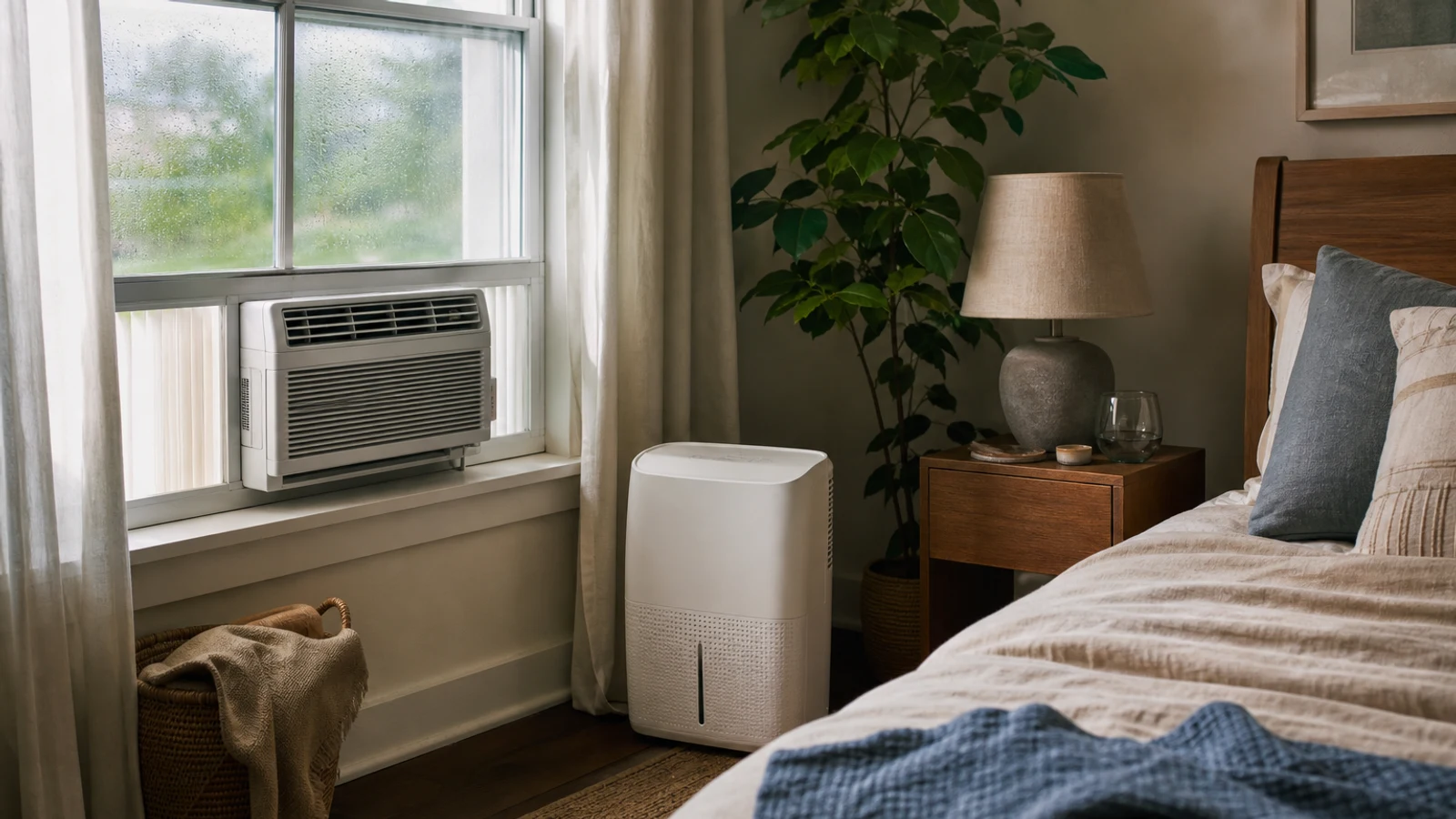
Choose a dehumidifier when the room is cool enough but feels damp, smells musty, or repeatedly measures above about 50% to 60% relative humidity. Choose an air conditioner when you also need meaningful cooling. An air conditioner can remove moisture while it runs, but an oversized unit, short cooling cycles, or mild weather can leave humidity behind. A portable dehumidifier removes moisture more directly but releases some heat into the room.
At A Glance
| Decision Point | Dehumidifier | Air Conditioner |
|---|---|---|
| Primary job | Removes moisture | Removes heat and cools |
| Best for | Damp rooms that are not too hot | Rooms that are hot and humid |
| Effect on room temperature | Usually adds some heat | Lowers room temperature |
| Humidity control | Direct, often with a humidistat | By-product of cooling; varies with runtime and sizing |
| Mild-weather use | Useful when cooling is unnecessary | May overcool the room |
| Heat rejection | Returns waste heat indoors | Sends heat outdoors |
| Typical maintenance | Empty or drain tank; clean filter | Clean filter; maintain coils and condensate drainage |
| Best first step | Measure humidity and size for room conditions | Size correctly for cooling load and humidity load |
The Short Version: Moisture, Heat, Or Both?
The decision becomes much easier when you separate two problems: temperature and moisture. An air conditioner is designed primarily to move heat out of a room or building. As warm air passes over its cold evaporator coil, some water vapor condenses and drains away. That means air conditioning can lower humidity, but moisture removal depends on the system running long enough and often enough.
A dehumidifier uses a similar refrigeration cycle, but its main job is moisture removal. In a typical portable model, air passes over a cold coil, water collects in a tank or drain hose, and the air passes over warm components before returning to the room. The result is drier air with a small amount of added heat.
For a room that is 75°F but feels clammy, a dehumidifier is usually the more targeted fix. For a room that is 85°F and humid, an air conditioner addresses both discomfort and moisture. If the room is already cool, using an air conditioner only to chase humidity can make the space uncomfortably cold.
- Mainly damp or musty: start with a dehumidifier.
- Hot and humid: use an air conditioner.
- Cool but persistently humid: consider a dehumidifier or whole-home humidity solution.
- Humidity returns quickly: investigate leaks, ventilation, drainage, or air leakage before buying a larger appliance.
Dehumidifier Vs Air Conditioner
Neither appliance is universally better. They solve overlapping but different parts of the problem, and the best choice depends on the room, climate, season, and whether you need cooling at the same time.
How The Two Appliances Differ
A portable dehumidifier measures its success by water removed and relative humidity maintained. Many models include a humidistat that lets you select a target humidity, allowing the compressor to cycle as conditions change. It is particularly useful in basements, laundry areas, bedrooms, storage rooms, and homes that become damp during spring or fall when outdoor temperatures are not high enough to justify air conditioning.
An air conditioner is controlled mainly by temperature. It may reduce humidity while cooling, but its moisture performance can vary considerably. A properly sized system generally runs long enough to remove moisture. An oversized system may reach the thermostat setting quickly, shut off, and leave the room cool but damp. This is one reason a lower temperature setting is not always the right humidity strategy.
Some air conditioners include a dry or dehumidify mode. That setting can be useful, but the exact behavior varies by design. It may reduce fan speed, change compressor operation, or prioritize moisture removal at the expense of cooling. Check the appliance manual rather than assuming every dry mode works the same way.
Which One Uses Less Energy?
There is no universal answer because the appliances perform different amounts of work. An air conditioner must remove heat from the room and reject it outdoors. A portable dehumidifier removes moisture but sends its waste heat back into the room, so it can make an already hot room less comfortable and may cause the air conditioner to run longer.
A dehumidifier can make sense during mild weather when the home needs moisture control but little cooling. In hot weather, running a dehumidifier and air conditioner separately may be less efficient than using a correctly sized air conditioner or a properly designed whole-home system. The right comparison is not simply the wattage printed on each appliance; it is the energy required to reach and maintain a comfortable temperature and humidity level.
When shopping, compare the dehumidifier’s integrated energy factor and look for an ENERGY STAR-certified model. For room air conditioners, compare the applicable efficiency information and avoid assuming that a larger capacity is better. Oversizing can increase purchase and operating costs while reducing moisture removal because of short cycling.
Choose A Dehumidifier When…
A dehumidifier is the stronger choice when moisture is the primary complaint and cooling is secondary. It is also useful when the air conditioner does not run long enough to control humidity or when a particular room is damp even though the rest of the home feels comfortable.
Set a target rather than running the appliance continuously without measurement. A hygrometer placed away from direct airflow can show whether the room is actually staying humid. Indoor humidity is generally best kept in the 30% to 50% range, while keeping it below 60% helps limit moisture-related problems. In colder weather, lower humidity may be needed to reduce window condensation.
Portable units require ongoing attention. You may need to empty the bucket, connect a drain hose, clean the filter, keep air inlets clear, and make sure the unit has enough space for airflow. A dehumidifier can also add noise and heat, so placement matters in a bedroom or small office.
- Basement or lower level feels damp despite a comfortable temperature.
- Laundry is drying indoors and moisture lingers.
- A bedroom feels clammy at night but does not need much cooling.
- Humidity remains high during mild spring or fall weather.
- You need a specific humidity target rather than temperature-only control.
Choose An Air Conditioner When…
An air conditioner is the better first purchase when the room is both hot and humid. It can improve comfort in two ways at once: removing sensible heat and condensing some moisture from the air. A window unit, portable air conditioner, ductless mini-split, or central system may be appropriate depending on the space and installation limits.
Correct sizing is important. A unit that is too small may run continuously and still fail to reach the desired temperature. A unit that is too large may cool the room rapidly but cycle off before removing enough moisture. For central systems, poor ductwork, restricted airflow, thermostat placement, or inadequate condensate drainage can also affect humidity performance.
If the air conditioner cools well but the home remains muggy, first check whether the system is short-cycling, whether filters and coils are dirty, and whether outdoor humid air is entering through leaks or ventilation problems. A separate dehumidifier may help, but persistent whole-home humidity can justify an HVAC evaluation rather than another room appliance.
- The room is uncomfortably hot as well as damp.
- You need cooling during the same hours that humidity is highest.
- The space has a suitable window, wall, or ducted installation option.
- You want moisture removed outdoors rather than heat added back into the room.
When A Combination Makes Sense
Some homes genuinely need both systems. A central air conditioner may handle summer heat while a whole-home or portable dehumidifier manages humidity during mild weather, in shaded rooms, or in a tightly sealed home with a persistent moisture load.
Combination use should be based on measurements and symptoms, not simply on the assumption that more equipment is better. If the air conditioner is already maintaining comfortable temperature and relative humidity, an extra dehumidifier may waste energy and add heat. If the air conditioner runs briefly but humidity stays high, supplemental dehumidification may be reasonable.
For whole-home problems, a ducted dehumidifier can provide more consistent control than moving a portable unit from room to room. Installation is more involved and typically requires professional sizing, drainage, electrical planning, and coordination with the HVAC system.
Solve The Moisture Source Before Buying
An appliance treats indoor air; it does not repair the reason moisture is entering. Before purchasing, look for plumbing leaks, wet foundation walls, groundwater intrusion, condensation on cold surfaces, unvented bathroom or kitchen moisture, clothes dryers venting indoors, and excessive outdoor-air infiltration.
Use exhaust fans during showers and cooking, vent the dryer outdoors, keep gutters and downspouts directing water away from the foundation, and repair visible leaks. Do not rely on a dehumidifier to hide active water intrusion or a recurring condensation problem.
If one room is much more humid than the rest of the home, measure there and inspect that room first. A damp basement, crawl space, bathroom, or exterior wall may require building repairs, improved ventilation, insulation, drainage work, or HVAC changes rather than a larger appliance.
Common Buying Mistakes
Buying the biggest portable unit is not automatically the best strategy. Capacity should reflect room size and how damp the space is. A mildly damp bedroom and a basement with visible seepage are different jobs.
Another mistake is treating a dehumidifier as an air conditioner. It may make the room feel less sticky, but it does not provide meaningful cooling and generally releases heat indoors. Conversely, treating an air conditioner as a dedicated humidity controller can lead to overcooling, short cycling, or disappointing results in mild weather.
Avoid placing either appliance where airflow is blocked. Keep filters and coils clean, provide the required clearance, and follow the manufacturer’s instructions for drainage and electrical use. Do not use extension cords unless the manual specifically permits it and the cord is appropriately rated.
- Do not buy before measuring relative humidity.
- Do not oversize an air conditioner to chase moisture.
- Do not expect a portable dehumidifier to cool a hot room.
- Do not ignore leaks, seepage, or inadequate bathroom ventilation.
- Do not run a bucket-style unit unattended if overflow or drainage is uncertain.
When To Call A Professional
Get an HVAC or building professional involved when humidity remains high throughout the home, condensation appears on walls or ducts, there is visible mold or water damage, the basement has seepage, or the air conditioner is short-cycling or failing to drain condensate properly.
Professional help is also worthwhile before installing a whole-home dehumidifier or replacing central air conditioning. The solution may involve sizing, duct sealing, ventilation, insulation, drainage, or air-sealing work. If moisture is causing structural damage, an appliance alone is unlikely to be a durable fix.
For a single room with moderate humidity and no signs of water intrusion, a correctly sized portable dehumidifier is often the simplest starting point. Measure the result after several days instead of judging by sound, warmth, or how much water collects in one afternoon.
The Bottom Line
Choose the appliance that matches the discomfort you actually have. An air conditioner is the better answer for a hot, humid room because it cools while removing some moisture. A dehumidifier is the better answer for a damp room that is otherwise cool or comfortable. In a whole home, the right solution may be source control, HVAC correction, supplemental dehumidification, or a combination.
Start with a hygrometer, identify where and when humidity rises, and check for moisture sources. Buying becomes much easier once you know whether the problem is heat, humidity, or both.
Questions & Answers
Practical follow-up questions readers often ask before acting or buying.
Can a dehumidifier replace an air conditioner?
Usually not. A dehumidifier removes moisture but normally releases heat into the room, so it cannot provide the cooling needed during hot weather. It can improve comfort in a room that is damp but not excessively warm.
Does an air conditioner dehumidify a room?
Yes, when its cold coil operates and moisture condenses from the air. However, the amount removed depends on sizing, runtime, humidity load, airflow, and the unit’s operating mode. A system that cools the room very quickly may not remove enough moisture.
What humidity level should I set on a dehumidifier?
A common starting range is 40% to 50% relative humidity. Keeping indoor humidity below 60% helps limit moisture-related problems, while colder weather may require a lower setting to reduce window condensation. Use a separate hygrometer if the appliance’s reading seems unreliable.
Why is my room humid even when the air conditioner is running?
Possible causes include an oversized or short-cycling system, a dirty filter or coil, inadequate airflow, condensate drainage problems, outdoor-air leaks, or a moisture source such as a basement, bathroom, or crawl space. Lowering the thermostat may not solve the underlying issue.
Does a dehumidifier make a room hotter?
A portable compressor dehumidifier generally adds some heat because it returns the appliance’s waste heat to the room. The room may feel more comfortable because the air is drier, but the appliance is not a substitute for cooling.
Should I buy a dehumidifier for a basement?
It may help if the basement is damp but does not have active water intrusion. First check drainage, gutters, foundation leaks, plumbing, and crawl-space conditions. If walls or floors are wet, solve the water problem before relying on a dehumidifier.
Sources & Further Reading
Advanced HVAC Humidity Control for Hot-Humid-Climates | Department of Energy
Dehumidifier Buying Guide - Consumer Reports