
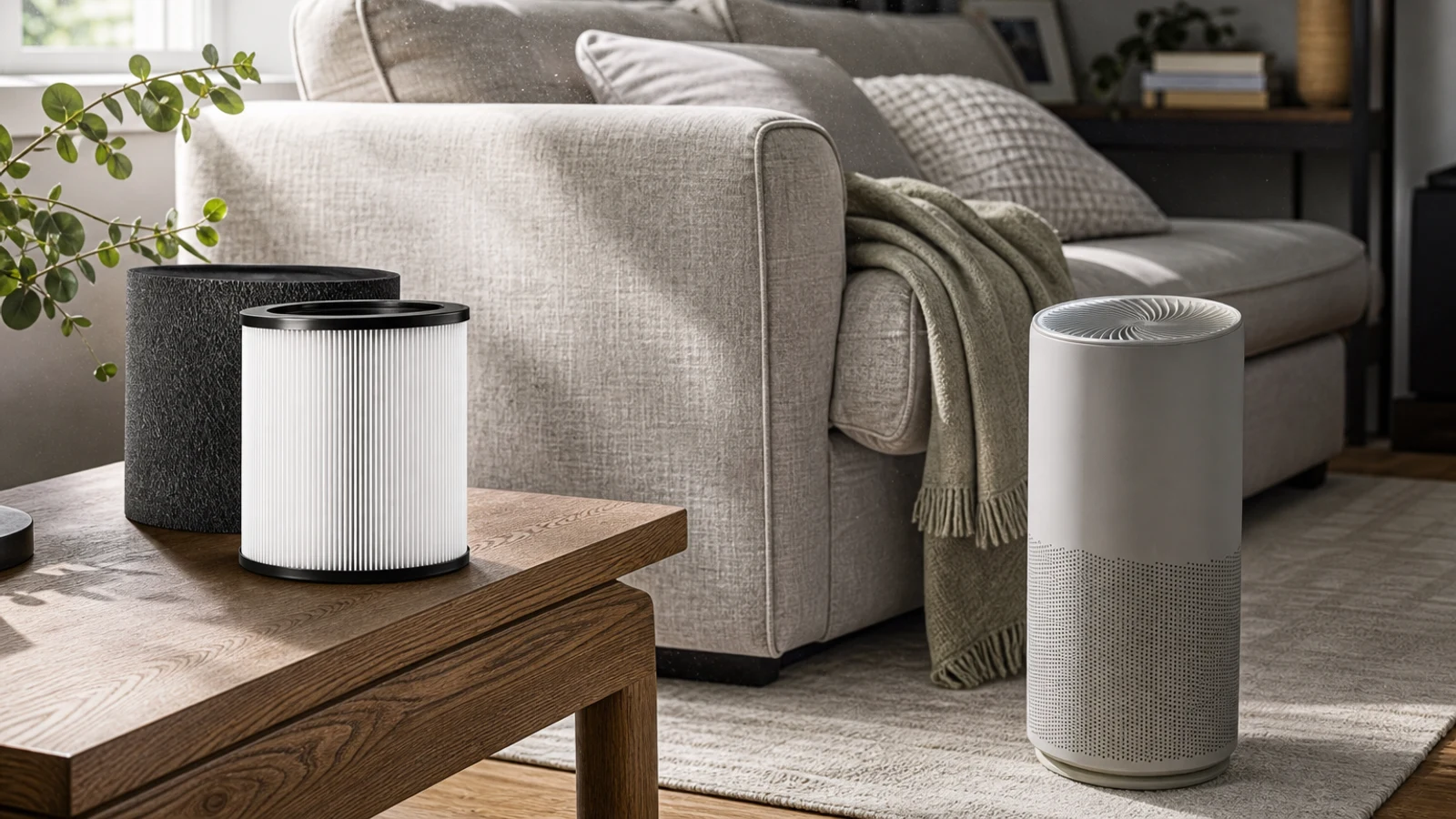
Choose HEPA for airborne particles such as dust, pollen, pet dander, mold particles, and smoke particles. Choose activated carbon for some odors and gaseous pollutants such as certain VOCs. A purifier with both can address particles and some gases, but carbon performance depends heavily on the amount and type of carbon, airflow, humidity, and how quickly the filter becomes saturated. Neither filter removes every indoor pollutant, and neither should replace source control or ventilation.
At A Glance
| Decision Point | HEPA | Activated Carbon |
|---|---|---|
| Best For | Airborne particles | Some gases and odors |
| Captures | Dust, pollen, dander, smoke particles | Some VOCs, vapors, and odor molecules |
| Removes Dust? | Yes, when airborne and drawn through the filter | No |
| Removes Odors? | Limited; mainly particle-related odor sources | Often better for suitable gases, while capacity lasts |
| Main Limitation | Does not remove gases effectively | Selective and eventually becomes saturated |
| What To Check | CADR, room size, airflow, filter seal | Carbon quantity, media type, airflow, replacement interval |
| Best Choice When | Dust, pollen, dander, or smoke particles are the concern | Chemical odors or certain gaseous pollutants are the concern |
The Basic Difference: Particles Vs. Gases
The most useful way to compare these filters is to identify the pollutant’s physical form. A particle is a tiny solid or liquid suspended in air. A gas is made of individual molecules that pass through ordinary particle filters. HEPA is designed for the first category; activated carbon is mainly used for the second.
That distinction explains why a purifier can noticeably reduce airborne dust while doing little for paint fumes, cleaning-product vapors, or persistent chemical odors. It also explains why a carbon filter may reduce an odor without removing the dust or smoke particles associated with the odor source.
- HEPA: mechanical particle capture
- Activated carbon: adsorption of some gases and odors
- Combined filters: broader coverage, but not unlimited removal
What A HEPA Filter Removes
A properly designed HEPA filter captures airborne particles by passing air through a dense fiber medium. EPA identifies dust, pollen, dust-mite and cockroach allergens, some mold, animal dander, tobacco smoke particles, and particles associated with bacteria and viruses among the types of indoor particles that mechanical filters can address.
A commonly cited HEPA performance benchmark is removal of at least 99.97% of particles at 0.3 micrometers under the applicable test conditions. That figure describes filter efficiency, not how quickly a whole room becomes cleaner. Real-world results also depend on airflow, room size, leaks around the filter, operating time, and whether the purifier has enough clean-air delivery for the space.
HEPA can capture the particle portion of smoke, but it does not make the gases and odor molecules in smoke disappear. A HEPA filter also cannot remove particles that have already settled on floors, upholstery, or other surfaces unless they are stirred back into the air and drawn through the purifier.
- Dust and airborne debris
- Pollen and many common allergens
- Pet dander
- Many smoke particles
- Some airborne mold, bacteria, and virus-sized particles
- Particles from combustion and outdoor pollution
What Activated Carbon Removes
Activated carbon is a porous adsorbent. Instead of trapping particles in a fiber maze, it attracts and holds some gas molecules on its internal surface. EPA describes gas-phase filters as systems that use sorbents such as activated carbon to remove gases and odors from the airstream.
Carbon may help with certain odors, hydrocarbons, aldehydes, organic acids, and other gaseous pollutants, depending on the carbon’s properties and the contaminant involved. Some filters add chemical treatments to target particular gases, but performance remains pollutant-specific rather than universal.
The biggest consumer mistake is treating any thin black filter sheet as a powerful VOC or odor solution. Carbon has limited capacity. Once much of the available adsorption surface is occupied, the filter becomes less effective and may need replacement. A thicker bed containing more carbon generally offers more opportunity for adsorption than a lightly carbon-coated filter, although design and airflow still matter.
Activated carbon is not a substitute for a smoke alarm, carbon-monoxide detector, ventilation, or fixing the source of a chemical release. EPA specifically notes that residential gas-phase filters should not be expected to remove all gaseous pollutants and are not a reliable solution for carbon monoxide.
- Some household odors
- Certain VOCs and chemical vapors
- Some hydrocarbons and aldehydes
- Some ozone, when the media is designed for it
- Not dust, pollen, pet dander, or most airborne particles
HEPA Vs. Carbon: A Practical Comparison
The better filter depends on the problem you are actually trying to solve. If the complaint is visible dust, allergy-triggering particles, wildfire smoke particles, or pet dander, HEPA is the relevant technology. If the complaint is odor or a chemical vapor, carbon is the relevant technology—but only if the filter is appropriately designed and still has usable capacity.
For many homes, a combination filter is the most flexible option. The HEPA layer handles particles while the carbon layer handles some gases. That does not mean a combination purifier is equally strong at both jobs. A compact carbon layer may provide modest odor reduction, while the same unit’s HEPA section may be very effective at particle removal.
- For dust and pollen: prioritize HEPA and adequate airflow
- For wildfire smoke: prioritize smoke CADR and HEPA; carbon may help with odor
- For pet dander: prioritize HEPA; carbon is optional for odor
- For cooking particles: prioritize ventilation and HEPA; carbon may help with some odors
- For paint or cleaning fumes: remove the source and ventilate; carbon may offer limited supplemental help
- For persistent chemical exposure: investigate the source rather than relying on a portable purifier
What Changes Real-World Performance
Filter labels alone do not tell you how well a purifier will clean a room. For HEPA, look at the unit’s airflow and clean-air delivery. EPA recommends considering CADR and choosing a unit sized for the room; a highly efficient filter moving too little air may clean more slowly than a somewhat less efficient system with substantially greater airflow.
For carbon, the amount of media is especially important. A thin impregnated sheet may be useful as a prefilter or for light odor control, but it has less capacity than a substantial carbon bed. Humidity, temperature, airflow speed, the contaminant’s concentration, and the carbon’s chemistry can all affect adsorption. EPA’s technical summary notes that adsorbents have limited capacity and that adsorption generally occurs more readily at lower temperatures and humidity.
Maintenance matters for both. A clogged HEPA filter restricts airflow. A saturated carbon filter may continue to look clean while providing little remaining gas removal. Follow the manufacturer’s replacement guidance, but replace sooner if airflow drops, odors return, or the filter has been exposed to an unusually heavy pollutant load.
- HEPA performance depends on airflow, room size, run time, and seal quality
- Carbon performance depends on media quantity, chemistry, humidity, and pollutant concentration
- A purifier cannot clean surfaces or eliminate an ongoing source
- A filter that is overloaded can perform very differently from a new one
How To Choose Without Overbuying
Start with the pollutant, not the marketing term. If your main goal is reducing airborne particles, a well-sized HEPA purifier may be enough. If you mainly want to reduce occasional household odors, a modest carbon stage may be useful, but ventilation and source control are often more effective. If you have both particle and odor concerns, choose a combination unit and inspect how much carbon it actually contains rather than assuming every ‘carbon filter’ is equivalent.
For HVAC systems, do not replace the manufacturer’s recommended filter with a much more restrictive option without confirming that the system can handle it. Portable purifiers are often simpler because they are designed around their own fan and filter combination. In either case, keep realistic expectations: filtration is a supplement to source control and clean-air ventilation, not a complete replacement.
You probably do not need to buy a purifier if the issue is a single fixable source, such as a dirty range hood filter, damp building material, a clogged vacuum, or an ongoing leak. Solve that source first. A purifier makes more sense when the source cannot be immediately eliminated, when particles are repeatedly generated, or when supplemental cleaning is practical for an occupied room.
- Buy HEPA-first for particle problems
- Buy carbon only when gases or odors are part of the problem
- Prefer both when you need particle and odor coverage
- Check airflow and room sizing, not just filter claims
- Do not use filtration to manage carbon monoxide or an active hazardous release
Common Mistakes To Avoid
The first mistake is assuming ‘HEPA’ means every type of pollution is removed. HEPA is a particle technology. The second is assuming activated carbon removes all odors or VOCs indefinitely. Carbon is selective and capacity-limited. The third is ignoring the source: a purifier cannot compensate for smoking indoors, inadequate kitchen ventilation, water damage, or a continuing chemical release.
Another mistake is focusing on a percentage without considering airflow. A filter’s capture efficiency and a room purifier’s total cleaning rate are different measurements. Finally, avoid units that intentionally generate ozone as a supposed purification strategy. EPA warns that some electronic air-cleaning devices can produce ozone, a lung irritant; particle and gas filtration should be evaluated separately from ozone-generating claims.
- Do not confuse odor reduction with removal of the source
- Do not treat a thin carbon coating like a large carbon bed
- Do not use an air purifier as a carbon-monoxide safety device
- Do not ignore ventilation, cleaning, or repairs
- Do not judge a purifier by filter efficiency alone
When Professional Help Is Appropriate
Seek professional help when you suspect mold inside building materials, a fuel-burning appliance problem, unusually strong chemical exposure, asbestos, radon, or a persistent indoor-air problem that does not improve after source control. A portable purifier may reduce some airborne particles, but it cannot diagnose the contaminant or make an unsafe building condition safe.
For immediate concerns involving carbon monoxide, leave the area and follow emergency guidance rather than waiting for a filter to work. Carbon filtration in a residential purifier should never be treated as a substitute for properly installed detectors, appliance maintenance, or emergency response.
Questions & Answers
Practical follow-up questions readers often ask before acting or buying.
Is HEPA better than activated carbon?
Neither is universally better. HEPA is better for airborne particles such as dust, pollen, pet dander, and smoke particles. Activated carbon is better suited to some gases and odors. A combination filter is the broadest option, but its carbon performance depends on the amount and type of carbon.
Can a HEPA filter remove odors?
HEPA may capture odor-carrying particles, such as some smoke particles, but it does not reliably remove gaseous odor molecules. Odor reduction usually requires source control, ventilation, and an appropriate gas-phase medium such as activated carbon.
Does activated carbon remove dust?
No. Activated carbon is primarily used for gases and odors, not airborne particles. A purifier intended to address both should include a separate particle filter, such as HEPA or another effective mechanical filter.
Can activated carbon remove VOCs?
It can adsorb some VOCs, but performance varies by chemical, carbon type, carbon quantity, airflow, humidity, and filter age. It should be treated as supplemental control, not a guarantee that all VOCs will be removed.
Do I need both HEPA and activated carbon?
Choose both if you want to address airborne particles and some odors or gaseous pollutants. If your only concern is dust, pollen, pet dander, or smoke particles, a well-sized HEPA purifier may be sufficient. If the main concern is a continuing chemical source, fix the source first.
Can a HEPA or carbon filter remove carbon monoxide?
Do not rely on either type for carbon monoxide protection. Use properly installed carbon-monoxide detectors, maintain fuel-burning appliances, and respond immediately to an alarm or suspected exposure.
Sources & Further Reading
Air Cleaners and Air Filters in the Home | US EPA
Guide to Air Cleaners in the Home | Indoor Air Quality (IAQ) | US EPA
Research Policies and Program Options for Improving Indoor Environmental Quality
Residential Air Cleaners - A Technical Summary
Air Cleaners, HVAC Filters, and Coronavirus (COVID-19) | US EPA