
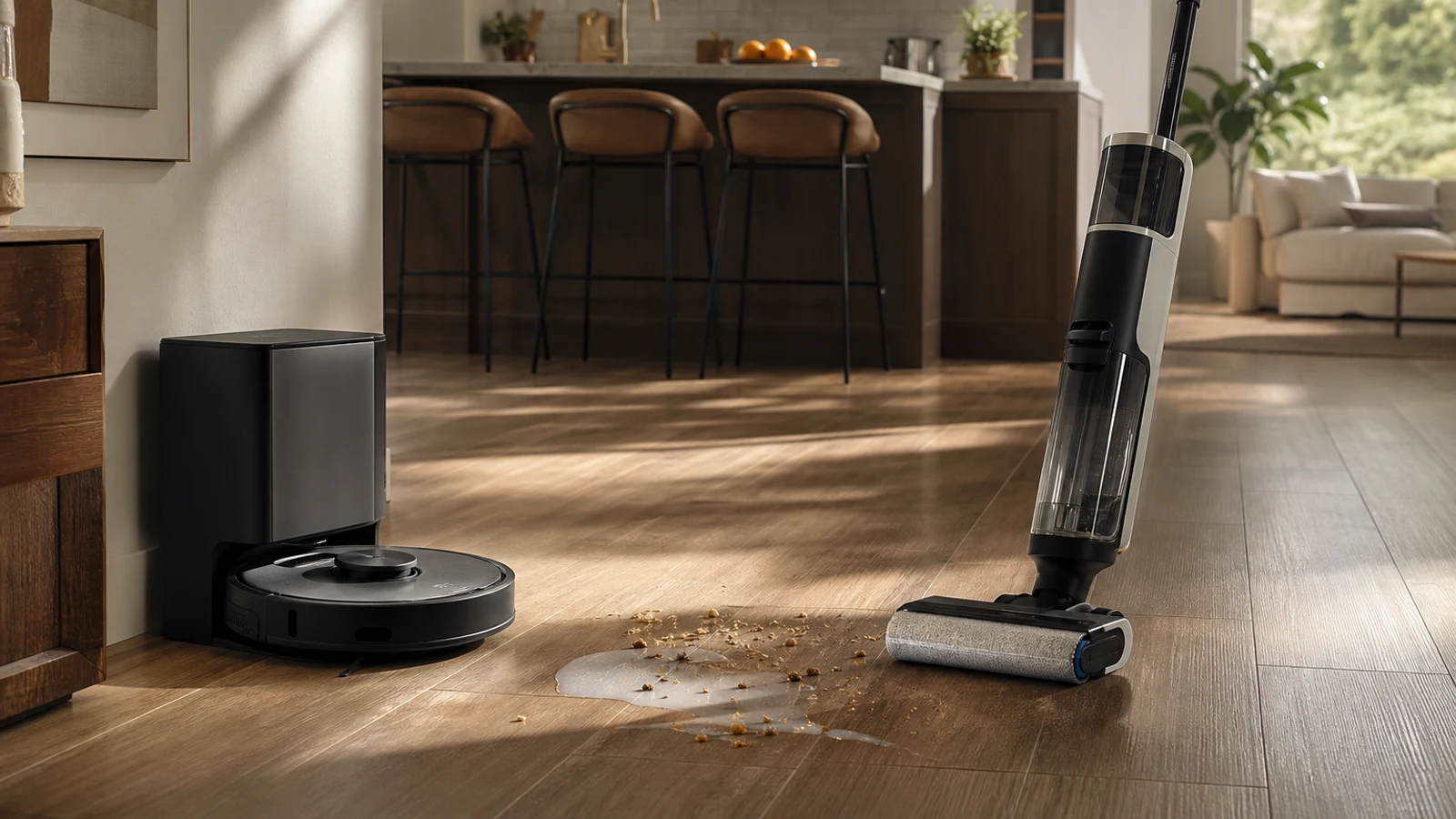
Choose a robot vacuum if you want recurring, hands-off floor maintenance across multiple rooms. Choose a wet-dry vacuum if you need fast control over spills, food messes and sticky hard-floor stains. A well-equipped robot vacuum-mop can narrow the gap, but it usually still requires more setup and is less immediate for messy accidents. If you have mostly hard floors and frequent kitchen or pet messes, using both can save the most total cleaning time.
At A Glance
| Decision Point | Robot Vacuum | Wet-Dry Vacuum |
|---|---|---|
| Main time-saving advantage | Runs with little hands-on effort | Cleans a messy area quickly when you operate it |
| Best for | Dust, crumbs, pet hair and recurring upkeep | Spills, sticky stains, food debris and muddy tracks |
| Floor coverage | Can cover multiple rooms on a schedule | You clean only the areas you push it across |
| Hard-floor washing | Routine mopping varies by model | Vacuuming and washing happen together |
| Carpet usefulness | Usually more suitable for routine carpet debris | Usually limited or unsuitable for carpet cleaning |
| Maintenance | Distributed upkeep for robot, dock and consumables | Tank, roller and filter care after use |
| Best ownership fit | Busy homes wanting recurring automation | Homes needing direct control over frequent messes |
The Short Version: Automation Vs Immediate Cleaning Power
Robot vacuums and wet-dry vacuums save time in fundamentally different ways. A robot works independently, usually following a schedule or app command. You spend time preparing the floor, maintaining the dock and occasionally rescuing it, but you do not need to stand behind it for every cleaning cycle.
A wet-dry vacuum, sometimes called a floor washer, requires you to push it across the floor. In return, it can collect dry debris, pick up liquid and scrub hard floors during the same pass. That makes it especially useful when the mess is already in front of you and cannot wait for a scheduled run.
This comparison assumes a cordless wet-dry floor cleaner such as a Tineco FLOOR ONE or BISSELL CrossWave, not a wet-dry shop vacuum. Shop vacs are better suited to garages, workshops, floods and heavy debris than routine kitchen-floor cleaning.
- Best for weekly time savings: Robot vacuum
- Best for a spill or sticky mess: Wet-dry vacuum
- Best for carpets: Usually a dedicated robot vacuum or conventional vacuum, not a floor washer
- Best overall setup for busy hard-floor homes: Robot for maintenance plus wet-dry vacuum for messes
Where A Robot Vacuum Saves More Time
The robot’s biggest advantage is that it turns cleaning into a routine rather than a task you must remember and perform. A scheduled robot can collect crumbs, dust and pet hair repeatedly, preventing buildup before a larger cleaning session becomes necessary. This is valuable in homes with pets, children, open-plan kitchens or occupants who are away during the day.
Higher-end robot vacuum-mop systems can now combine mapping, room-by-room scheduling, automatic dust emptying, mop washing, mop drying and water refilling. Those features reduce the amount of daily intervention, although they do not eliminate maintenance. The dock still occupies floor space, and the robot’s base, brushes, filter, water system and sensors need occasional attention.
The time savings are greatest when your home is easy for a robot to navigate. Hard floors, open pathways, limited clutter and a single level create favorable conditions. If you must pick up cords, toys, pet bowls and clothing before every run, the robot may shift work rather than eliminate it.
Robots are also useful because they clean when you are not actively available. A wet-dry vacuum may finish a room faster in elapsed cleaning time, but it cannot clean while you are on a work call or out of the house. For recurring maintenance, that distinction matters more than raw suction claims.
- Strongest fit: Dust, crumbs, hair and light daily debris
- Useful feature: Scheduling by room or zone
- Time penalty: Floor preparation and occasional stuck-robot interventions
- Ongoing work: Emptying or replacing consumables and cleaning the dock
Where A Wet-Dry Vacuum Saves More Time
A wet-dry vacuum wins when the floor needs attention now. Its powered roller can pick up crumbs and liquid while scrubbing the surface, so you do not need to sweep first and mop afterward. For a breakfast spill, muddy paw prints or dried food near a high chair, that direct control can be faster than waiting for a robot to run a suitable cycle.
These machines are particularly effective on sealed hard floors such as tile, vinyl, laminate approved by the manufacturer and finished wood approved for wet cleaning. They are not general-purpose carpet vacuums. Some models can refresh area rugs, but many are designed primarily for hard floors, and their wet-cleaning systems are not a replacement for a powerful carpet vacuum.
The trade-off is that every cleaning session requires your involvement. You must charge the machine, fill the clean-water tank, empty the dirty-water tank and usually run a self-cleaning cycle. The brush roller and filter may also need to be removed and dried. Skipping that care can lead to odors and reduced performance, so the appliance saves floor-cleaning time but adds a small equipment-maintenance routine.
Wet-dry vacuums also have a practical advantage in small homes. They generally take up less permanent floor space than a robot with a large multifunction dock, and you can carry one directly to the problem area rather than clearing an entire room for autonomous navigation.
- Strongest fit: Spills, sticky stains, food debris and muddy tracks
- Useful feature: Simultaneous vacuuming and washing
- Time penalty: You must push it and clean the tanks and roller
- Main limitation: Usually intended for sealed hard floors
Head-To-Head: Which One Saves More Time?
The answer depends on whether you are measuring hands-on minutes or total household effort. A wet-dry vacuum often finishes a dirty hard-floor area faster once you start using it. A robot usually saves more hands-on minutes over days and weeks because it can run repeatedly without you.
Do not compare a basic robot vacuum with a premium robot vacuum-mop dock and assume they provide the same experience. A vacuum-only robot can maintain dry debris but cannot replace a floor washer for spills. A robot with rotating or vibrating mops may handle routine floor washing, but performance varies considerably by model, floor type and stain.
Independent testing also suggests that robot vacuum-mop performance is uneven. Some units are good at bare floors and mopping, while carpet pickup, edge cleaning and obstacle avoidance can remain model-specific weaknesses. That means a robot’s convenience should not be confused with universal deep-cleaning ability.
- For daily crumbs and pet hair: Robot vacuum usually wins
- For one large sticky mess: Wet-dry vacuum usually wins
- For multiple rooms while nobody is home: Robot vacuum wins
- For precise spot cleaning: Wet-dry vacuum wins
- For carpet-heavy homes: Neither wet-dry floor washer is a complete solution
- For minimal daily involvement: A robot with an automated dock wins
Maintenance And Hidden Time Costs
The robot’s maintenance is distributed over time. You may need to clear hair from the brush, clean sensors, wash filters, replace dust bags and wipe the dock. Robot-mop models add clean-water and dirty-water handling, mop-pad care and dock cleaning. Automated washing and drying reduce the chore, but the dock itself is not maintenance-free.
The wet-dry vacuum’s maintenance is concentrated after use. You typically empty dirty water, rinse or run the self-clean cycle, clean debris from the brush area and leave washable parts to dry. That can feel like a reasonable trade for a quick cleanup, but it becomes more noticeable if you use the machine several times every day.
Consumables also matter. Robots may use dust bags, filters, brushes and mop pads. Wet-dry vacuums may require replacement rollers, filters and cleaning solution, depending on the model. Before buying, check the manufacturer’s support pages for the availability and cost of these parts rather than judging only the purchase price.
A robot with a complicated dock can minimize hands-on work but increase the number of components that eventually need cleaning or replacement. A wet-dry vacuum is simpler to understand, but its dirty-water path and roller must be kept clean. Neither category is truly maintenance-free.
- Robot maintenance is lower-touch but more distributed
- Wet-dry maintenance is faster to understand but happens after each use
- Check replacement rollers, filters, pads, bags and cleaning solution before buying
- A self-cleaning cycle does not mean every internal part stays clean automatically
Which One Should You Buy?
Buy a robot vacuum if your main complaint is that floors become dusty or hairy before you have time to clean them. It is the better choice for recurring upkeep, especially in homes with open layouts and predictable schedules. A robot-mop model makes more sense if most floors are sealed hard surfaces and you want light routine mopping as part of the same automated cycle.
Buy a wet-dry vacuum if your main complaint is visible mess. Choose it when spills, cooking residue, pet accidents or muddy footprints are common and you want to clean them immediately. It is also a better choice when you dislike app setup, do not want a permanent dock or prefer to decide exactly where and how intensely to clean.
Skip a wet-dry floor washer if you primarily need carpet cleaning, above-floor attachments, upholstery tools or stair cleaning. Skip a robot if your floors are heavily cluttered, your home has many thresholds or stairs, or you are unwilling to perform the preparation and maintenance that autonomous cleaning requires.
If you already own one category, the other can complement it rather than duplicate it. A robot can handle routine dry debris while a wet-dry vacuum handles kitchen spills and periodic deep cleaning. That combination is most defensible in hard-floor homes where both recurring dust and frequent wet messes are real problems.
- Choose robot vacuum: You want cleaning to happen automatically
- Choose wet-dry vacuum: You want the fastest response to messes
- Choose both: You have pets, children, mostly hard floors and frequent daily debris
- Choose neither as your only cleaner: You have substantial carpet or stairs
How To Get The Most Time Savings
For a robot, create a realistic schedule rather than running it only when the floor looks dirty. Keep the main paths clear, use no-go zones around fragile objects and place the dock where it can be reached without blocking a walkway. If the robot has mopping capability, set carpet-avoidance or mop-lifting rules carefully and follow the manufacturer’s floor restrictions.
For a wet-dry vacuum, keep the clean-water tank filled only when you expect to use it, and empty the dirty tank promptly after cleaning. Run the self-cleaning cycle immediately, then let removable parts dry. Store the machine where it is easy to grab; a device hidden in a closet is less likely to save time during small messes.
The most efficient routine is often division of labor: schedule the robot for dry maintenance and use the wet-dry vacuum for spills, entryways, kitchens and periodic scrubbing. That approach prevents you from asking either machine to do a job it is not designed to handle.
- Automate recurring dirt; handle urgent messes manually
- Clear the robot’s path before scheduled runs
- Keep the wet-dry vacuum accessible for short cleanups
- Treat dock and roller care as part of ownership, not an optional extra
Questions & Answers
Practical follow-up questions readers often ask before acting or buying.
Can a robot vacuum replace a wet-dry vacuum?
Usually not completely. A robot can maintain floors and some robot-mop models can remove light stains, but a wet-dry vacuum is better for immediate spills, sticky food, muddy tracks and concentrated scrubbing on hard floors.
Is a wet-dry vacuum better than a robot for pet hair?
It depends on the location. A robot is better for collecting loose hair across the home on a schedule. A wet-dry vacuum is better for hair mixed with liquid, tracked-in dirt or messes concentrated on hard floors.
Do robot vacuum-mops clean as well as wet-dry vacuums?
They can handle routine mopping, but results vary widely. A wet-dry vacuum gives you more direct control and generally has an advantage on fresh spills and stubborn localized messes. Robot-mop performance depends on the model, mop design, water management and stain type.
Which is easier to maintain?
Neither is maintenance-free. A robot spreads maintenance across the week and may automate dust and mop handling through its dock. A wet-dry vacuum is simpler to operate but usually needs dirty-water, roller and filter care after each use.
What if my home has both carpets and hard floors?
A robot vacuum is generally more versatile for routine cleaning across mixed floors, provided it can avoid wet areas and lift or remove its mop. Add a wet-dry vacuum only if hard-floor spills and scrubbing are frequent enough to justify a second appliance.
Sources & Further Reading
3 Best Robotic Vacuum-Mop Combos, Lab-Tested and Reviewed - Consumer Reports
Roborock Qrevo S5V Robot Vacuum with Multifunctional Dock | Roborock US Official Store
Tineco FLOOR ONE S7 Stretch Steam intelligent wet dry vacuum cleaner – Tineco US