
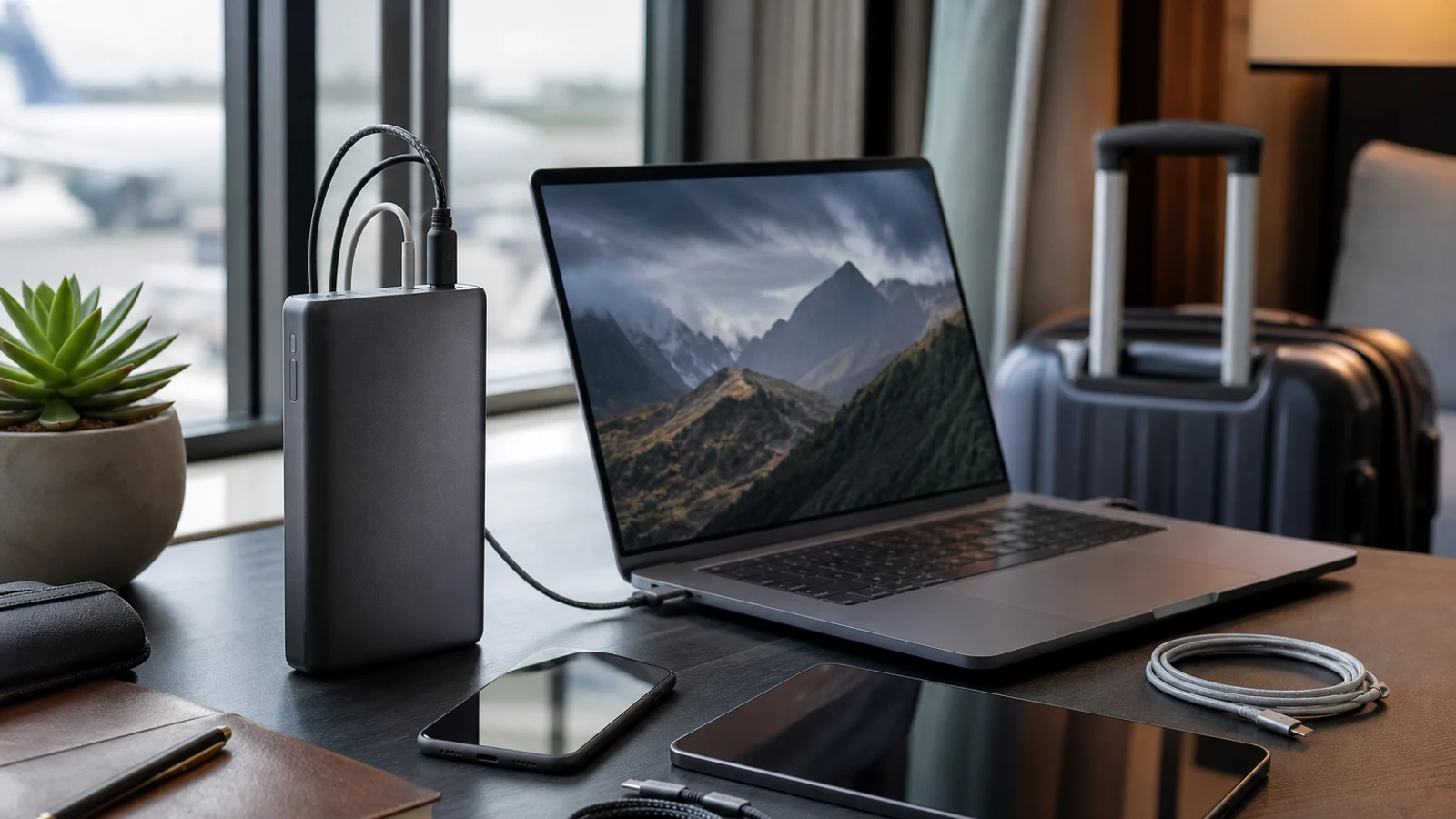
The Anker Prime Power Bank is worth considering for MacBook users, frequent travelers with several high-power devices, photographers, creators and mobile professionals who need laptop-class charging away from an outlet. Most phone users should skip it and buy a smaller 10,000mAh or 20,000mAh power bank instead. This is a research-based review of the current Anker Prime Power Bank (26K, 300W, model A110A), not hands-on testing.
Which Anker Prime Power Bank Is This Review About?
Anker uses the Prime name across several power banks, so the title needs a model-level clarification. The current flagship is the Anker Prime Power Bank (26K, 300W), model A110A, with a rated capacity of 26,250mAh and a battery energy rating of 99.75Wh. It has two USB-C ports, one USB-A port, a display, Bluetooth app support and a maximum total output of 300W.
The older Anker Prime Power Bank (27K, 250W), model A1340, has a slightly larger stated capacity of 27,650mAh, up to 250W total output and a 170W maximum recharge rate. Anker’s U.S. site currently lists that older model as sold out, while the 26K, 300W version is the active flagship. Buyers comparing listings should check the model number rather than relying on the word Prime alone.
- Current model covered here: Anker Prime Power Bank (26K, 300W), model A110A.
- Older model: Anker Prime Power Bank (27K, 250W), model A1340.
- Both models are close to the 100Wh airline limit, so airline rules still matter.
What You Get For The Money
The main appeal is concentrated charging power. The current 26K model can supply up to 140W from a single USB-C connection, which is enough to fast-charge many USB-C laptops that support high-wattage Power Delivery. Its two USB-C ports can also share power between two demanding devices, while the USB-A port handles lower-power accessories such as earbuds, watches, cameras or older cables.
The 300W figure is a total power budget, not 300W from one port. That distinction matters. A laptop may receive up to 140W, while the remaining output is distributed among the other connected ports. The power bank is therefore most useful when you are charging a laptop alongside a phone, tablet or accessories—not because any single phone needs hundreds of watts.
The current model also supports up to 250W input when both USB-C ports are used with suitable chargers and cables. That can reduce downtime for people who use the bank heavily, but it adds another cost and setup requirement: you need compatible high-output wall chargers, appropriate USB-C cables and access to two charging inputs.
- Two USB-C ports support laptop-class charging.
- One USB-A port remains useful for low-power or older accessories.
- The headline 300W rating is shared across ports.
- Maximum performance depends on the device, cable and charger.
Who Should Buy It
The clearest buyer is someone who regularly carries a USB-C laptop and cannot count on an outlet. A MacBook Pro user, Windows laptop owner, mobile video editor, photographer, remote worker or business traveler can use this capacity as a backup power source for a workday. The 99.75Wh rating is also close to the practical ceiling for a power bank carried on many commercial flights, although passengers should confirm current airline requirements before traveling.
It also makes sense for people carrying several high-power devices. A laptop, phone, tablet, handheld gaming device and camera batteries can quickly overwhelm a small power bank. The Prime’s display and app provide more useful information than a basic four-light indicator, including charging activity and power draw. For a power user, that visibility can help identify a weak cable, an inefficient device or a pack that needs recharging.
A third audience is anyone who wants one bank for both travel and emergency charging. It can keep communications devices and a laptop running during short outages, but it is not a substitute for a power station. There is no AC outlet, and it cannot run devices that require conventional wall power.
- MacBook and Windows laptop users who work away from outlets.
- Frequent travelers with several USB-C devices.
- Creators carrying cameras, tablets, laptops and accessories.
- People who value charging data and app-based monitoring.
Who Should Skip It
Most smartphone owners should skip this model. A 26K power bank is far more capacity than necessary for occasional phone top-ups, and the physical size makes it less convenient for a pocket, small purse or lightweight day bag. A smaller 10K or 20K model will usually be easier to carry and less expensive.
It is also a poor fit if your devices charge slowly. A phone that accepts only modest USB-C power cannot take advantage of 140W output, and the extra wattage will not make that phone charge at its advertised maximum. The Prime is valuable because it combines capacity with laptop charging—not because the number on the box is large.
Finally, skip it if you expect integrated cables, wireless magnetic charging or an AC outlet. The Prime is a traditional wired USB power bank. Anker sells other models with built-in cables and smaller travel formats that may better match casual use.
- Phone-only users who want a light everyday carry.
- Anyone who rarely charges a laptop from a battery.
- Buyers who want built-in cables or wireless charging.
- People unwilling to carry roughly 1.3 pounds of battery hardware.
Portability And Travel Trade-Offs
The current 26K model measures about 6.3 by 2.5 by 1.5 inches and weighs roughly 599 grams, or 1.32 pounds. That is relatively compact for nearly 100Wh of capacity, but it is not small in everyday terms. It belongs in a backpack, briefcase or camera bag rather than a jeans pocket.
Its capacity is close to the commonly referenced 100Wh airline threshold. That makes it more travel-friendly than larger battery stations, but it does not guarantee unrestricted carriage. Airlines can impose additional limits, require carry-on transport or ask passengers to remove power banks during screening. Never pack this type of battery in checked luggage, and verify the rules for the airline and itinerary.
The weight is easier to justify when the bank replaces a laptop charger, phone charger and separate backup battery. If it is added on top of all those accessories, the travel advantage becomes less convincing.
- Carry it in cabin baggage, not checked luggage.
- Verify airline policies before every trip.
- Consider the weight of the power bank plus the chargers needed to recharge it.
- Its size is reasonable for its capacity but not pocket-friendly.
The Display And App Are Useful, Not Essential
The front display shows battery information and charging activity, while the Anker app can provide real-time statistics, device-management features and firmware updates. Those tools are useful for people who want to know whether a laptop is drawing 20W or 100W, how quickly the bank is recharging or whether a connected device has stopped accepting power.
The app also adds a locating feature and charging controls, but it introduces Bluetooth dependence and another account or software relationship. Casual users may prefer a simple power button and battery indicator. The display is a genuine advantage for troubleshooting, though it does not change the basic limitations of battery conversion losses or device compatibility.
Buyers should also remember that advertised capacity is measured at the internal battery voltage. The usable energy delivered through USB-C will be lower after voltage conversion, heat and charging losses. A 99.75Wh bank should not be expected to deliver a full 99.75Wh to a laptop.
- Best for users who monitor power draw or manage several devices.
- Less valuable if you only need occasional phone charging.
- App features require Bluetooth and compatible software.
- Usable output will be lower than the stated internal battery energy.
Important Buying Considerations
Check the laptop’s charging requirements before buying. A USB-C port rated for 100W or 140W does not guarantee every laptop will accept that much power, and some models need a specific cable or proprietary charging method. Apple laptops may require the appropriate USB-C-to-MagSafe cable for their fastest charging behavior.
Budget for the input side as well. The power bank may support very fast recharging, but reaching the maximum requires a suitable high-output wall charger and cables. If you own only a 30W phone charger, the Prime will still recharge, but much more slowly than its headline input figure.
Also consider the accessory ecosystem. The Prime can work as a standalone power bank, but Anker’s charging-base accessories make desk use more convenient. Those accessories add cost and reduce the value proposition if you mainly use the product on occasional trips.
Finally, compare the current model with the older 27K version only after checking availability, price and warranty support. The older bank has a slightly larger stated capacity, while the newer version raises total output and maximum input. The newer one is the more relevant model for current buyers, but the older version could still be attractive if obtained from a reputable seller with clear return coverage.
- Confirm your laptop’s actual USB-C charging wattage.
- Use cables rated for the power level you intend to draw.
- A high-output wall charger may be required for fast recharging.
- Check return and warranty support when buying an older or marketplace unit.
Research-Based Verdict
The Anker Prime Power Bank is a specialist product that solves a real problem: keeping a laptop and several other devices running when wall power is unavailable. Its combination of near-100Wh capacity, 140W single-port output, 300W shared output, fast self-recharging and detailed monitoring makes it more capable than an ordinary phone power bank.
That capability comes with meaningful trade-offs. It is heavy, expensive relative to basic power banks, dependent on high-wattage cables and chargers, and unnecessary for many households. The 300W headline can also mislead shoppers who do not understand that total output is shared and that most phones cannot use anything close to it.
Buy the current Anker Prime Power Bank (26K, 300W) if you regularly carry a laptop and need dependable USB-C power away from outlets. Skip it if your goal is simply to recharge a phone during errands, flights or occasional emergencies. For that audience, a smaller power bank will be easier to carry and a better use of your money.
- Best reason to buy: laptop-class charging with nearly 100Wh of capacity.
- Biggest drawback: substantial weight and overkill for phone-only users.
- Best audience: mobile professionals, creators and frequent travelers.
- Bottom line: powerful and well-equipped, but not a general-purpose buy for everyone.
Questions & Answers
Practical follow-up questions readers often ask before acting or buying.
Which Anker Prime power bank is current?
Anker’s current flagship is the Prime Power Bank (26K, 300W), model A110A. The older Prime Power Bank (27K, 250W), model A1340, remains a separate product and is listed as sold out on Anker’s U.S. site.
Can the Anker Prime charge a MacBook Pro?
Yes, it can provide up to 140W through a compatible USB-C connection, which is suitable for many MacBook Pro configurations. Actual charging speed depends on the MacBook model, cable and charging method.
Is the Anker Prime power bank allowed on airplanes?
Its stated battery energy is just under 100Wh, a common airline threshold for spare batteries in carry-on luggage. Airline policies can differ, so confirm the rules for your specific carrier and route before flying.
Does the Anker Prime include a wall charger?
The power bank is sold as a battery accessory, and fast self-recharging requires a compatible high-output charger and cable. Check the exact package contents for the listing you plan to buy.
Is 300W useful for a phone?
Usually not. Most phones accept substantially less power than 300W. The high total rating is mainly useful for sharing power among a laptop, tablet, phone and accessories.
Should I buy the 250W or 300W Anker Prime?
For a new purchase, the current 26K, 300W model is the more relevant option because it offers higher total output and faster maximum input. The older 27K, 250W model may still make sense only if it is available from a trustworthy seller at a compelling price with clear support.
Sources & Further Reading
Anker Prime Power Bank (27K, 250W) - Anker US
Anker Prime 27650mAh 250W Power Bank review: The best power bank I've ever used | Android Central
Anker Prime Power Bank 27,650mAh 250W Portable Charger Review - Consumer Reports