
Choose a portable power station by matching watt-hours for runtime, continuous watts for devices you can run at once, and surge watts for appliances with motors or compressors. Add your devices’ watt-hours, allow room for conversion losses and avoid paying for capacity you rarely need. Small units suit phones and laptops, mid-size models suit weekend camping and limited emergency backup, and larger expandable units are better for refrigerators, power tools or longer outages.
Start With What You Actually Need To Power
Before comparing brands, list every device you expect to use and how long it must run. Phones, cameras, laptops and LED lights have very different demands from refrigerators, CPAP machines, microwaves, induction cooktops or circular saws. The common mistake is buying a large station for a vague emergency scenario without identifying the loads that matter.
Separate occasional charging from sustained loads. Phones and laptops usually need less total energy, while a refrigerator, heated blanket or medical device can consume power for many hours. Motor-driven devices also need extra power briefly when they start, which affects the station’s output rating.
- Camping electronics: phones, cameras, lights, speakers and laptops.
- Emergency essentials: phones, internet equipment, lights, medical devices and a refrigerator.
- Worksite use: chargers, lights, drills, saws and other power tools.
- RV or van use: 12-volt appliances, laptops, cooking equipment and refrigeration.
Understand Watts, Watt-Hours And Surge Watts
Watts, abbreviated W, describe power draw at a given moment. Watt-hours, or Wh, describe stored energy. A 100-watt device running for three hours uses roughly 300 watt-hours before conversion losses and standby consumption.
Continuous output is the power a station can provide for an extended period. Surge or peak output is a short-term allowance for startup demand from refrigerators, pumps, fans, compressors and power tools. A high surge number does not compensate for insufficient continuous output or battery capacity.
Use continuous output as the primary rating and treat peak output as a compatibility requirement. If a refrigerator needs a startup surge the station cannot deliver, it may fail to start even when its normal running wattage is below the station’s rating.
- Runtime estimate: usable watt-hours divided by device watts.
- Total simultaneous load: add the running watts of devices used together.
- Startup check: compare surge output with the highest starting demand.
- Leave headroom rather than operating the station at its limit.
Calculate Capacity Without Buying Too Much
Estimate capacity by multiplying each device’s wattage by its expected hours of use, then adding the results. A 60-watt laptop used for five hours would require about 300 watt-hours. A 10-watt light used for five hours would bring the basic total to roughly 350 watt-hours.
That total is not the battery size you should automatically buy. AC outlets use an inverter, and efficiency varies with load, temperature and the station’s electronics. Devices may also cycle rather than draw their listed wattage continuously. Add a buffer of roughly 20% to 50%, depending on the uncertainty in your calculations.
A total of 350 watt-hours may point to a station near 500 watt-hours for occasional laptop and lighting use, rather than a 1,000-watt-hour model. Overnight refrigerator or CPAP use can justify more capacity. The goal is to cover the use case with a reserve, not maximize the number on the box.
- Use measured wattage when possible.
- Calculate devices separately when usage times differ.
- Allow for inverter losses, standby draw and uncertain cycling.
- Remember that cold temperatures can reduce practical battery performance.
Choose A Useful Output Rating
Capacity and output are separate decisions. A station can have plenty of watt-hours but fail to run a high-demand appliance if its inverter lacks sufficient continuous power. Conversely, a high-output station with a small battery may run a power tool briefly but provide limited endurance.
For phones, tablets, cameras and many laptops, lower output may be sufficient. A mid-range inverter is more useful for multiple electronics, small appliances, refrigerators and selected power tools. High-output models suit more demanding appliances but are usually heavier, more expensive and less convenient to transport.
Do not assume a temporary marketing mode will operate every appliance normally. Read the manual for limitations, supported loads and whether special modes are unsuitable for heating elements, motors or sensitive equipment.
- Check continuous AC output, not just the peak figure.
- Confirm the station can run the heaviest device alongside other planned loads.
- Look for pure sine-wave AC output for sensitive electronics, motors or compressors.
- Avoid paying for high inverter output if your devices are low demand.
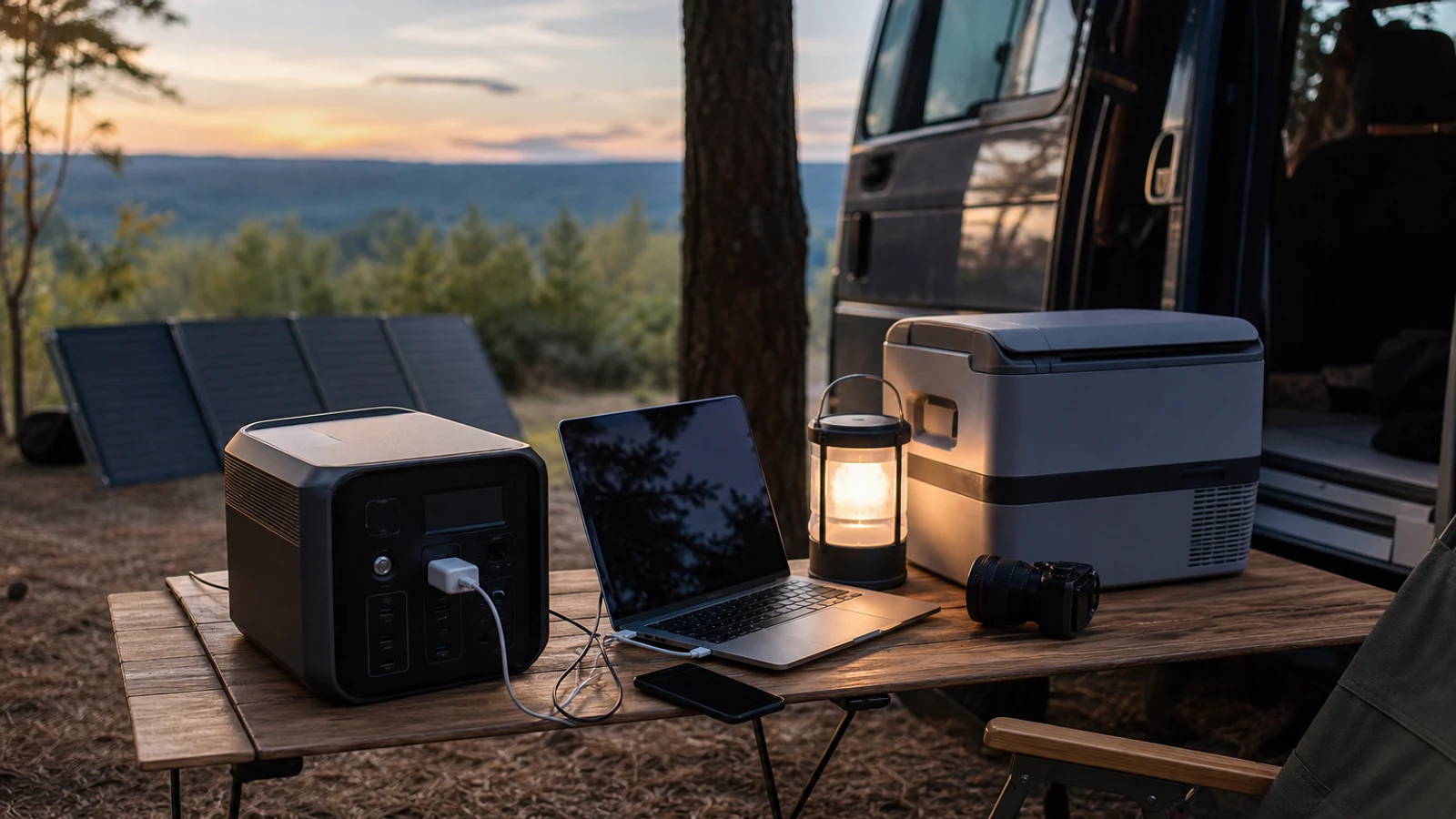
Compare options as you read
Explore options related to this guide. Check the exact product, seller, specifications and current price on Amazon. Image is illustrative.
As an Amazon Associate I earn from qualifying purchases.
Pick The Right Size Class
Small stations are easiest to carry and suit short trips, communication gear, lights and laptops. Their limitations include shorter runtime, fewer AC outlets and less ability to start motor-driven appliances. They are often best when portability matters more than household backup.
Mid-size stations offer a practical compromise for many campers and emergency kits. They provide more usable energy for refrigeration, lighting and electronics while remaining movable by one person, although weight varies by battery size and construction.
Large stations suit extended backup, RV living, high-demand appliances and job-site equipment. They can be difficult to lift, store and recharge, especially with expansion batteries or solar panels. Extra capacity is less useful if you cannot move the unit where it is needed.
- Small: personal electronics, lights and brief outings.
- Mid-size: weekend camping, refrigerator support and essential outage loads.
- Large: extended backup, RV use, demanding appliances and expandable systems.
- Wheels can help with large capacity, but not over stairs or rough ground.
Compare Battery Chemistry And Lifespan Claims
Many portable power stations use lithium iron phosphate, commonly called LiFePO4 or LFP. It is often favored for potential cycle life and stability characteristics, but the chemistry label alone does not establish how long a product will last. Check stated cycle conditions, usable-capacity definitions, charging limits and warranty terms.
Cycle counts may be measured until the battery reaches a specified remaining capacity, using conditions that differ between products. A station used occasionally for camping may age differently from one kept near full charge and discharged heavily during frequent outages.
Also check whether the battery is user-replaceable, whether expansion batteries are supported and whether service information is clear. A replaceable or expandable design may matter more than slightly higher starting capacity for long-term regular use.
- Prefer clearly documented chemistry and test conditions.
- Check usable capacity rather than only nominal capacity.
- Review warranty length and exclusions.
- Do not treat a cycle rating as an exact household service-life prediction.
Do Not Ignore Charging Speed And Inputs
A power station is useful only when it can be replenished. AC charging is usually predictable. Solar charging can extend off-grid use but depends on panel wattage, sunlight, temperature, shading and the station’s solar input limits. Car charging can help during travel but may be slower than wall charging.
Compare maximum AC charging rate, solar input range, connector type and whether multiple charging sources are supported. Solar panels must be electrically compatible; panel wattage alone is not enough if voltage or current falls outside the accepted range.
Fast charging can help before an outage or departure but may add cost, fan noise or heat. Occasional weekend users may not need the fastest recharge, while emergency-kit users may value faster recovery.
- Check AC, solar and vehicle charging times separately.
- Match solar voltage and current to the station’s input limits.
- Confirm whether charging and discharging can happen simultaneously if needed.
- Consider where the station will recharge, not only where it will operate.
Inspect Ports, Compatibility And Controls
Port selection can determine whether a station is convenient. Count the AC outlets, USB-C ports, USB-A ports, 12-volt outputs and vehicle-style sockets you actually need. High capacity is less useful if one suitable port forces you to carry adapters or a power strip.
USB-C Power Delivery can power compatible laptops, tablets and phones without using the AC inverter, potentially reducing conversion losses. Check the individual port rating and combined output limit when several ports operate together.
A clear display, low-power mode, optional app controls and cable storage can also matter. Some stations draw power while the AC inverter or display remains active, so automatic timeout or low-power settings may improve runtime.
- Match port types to your devices before buying adapters.
- Check individual and combined USB-C limits.
- Verify 12-volt connector compatibility for refrigerators and accessories.
- Look for a readable display and controls that work without an app.
Treat Safety And Intended Use Seriously
A portable power station is not automatically a substitute for a permanently installed home battery system. To connect backup power to household wiring, use an approved transfer solution, follow local electrical requirements and consult a qualified electrician. Never feed power through a wall outlet.
Look for safety testing or certification information, clear model identification, a real manual and a published recall process. Battery products can present overheating, fire and shock hazards when damaged, modified, charged incorrectly or used outside instructions. Inspect a unit after drops, water exposure or swelling, and stop using it if it appears damaged.
These stations do not produce engine exhaust, but they still require proper use. Keep the unit dry, provide recommended ventilation, follow temperature limits and use suitable charging equipment.
- Do not connect a portable station to home wiring without an approved transfer solution.
- Check the exact model for recalls before buying new or used.
- Follow charging, storage and temperature instructions.
- Stop using a unit that is swollen, cracked, overheating, smoking or behaving abnormally.
A Simple Buying Checklist
Once you know your loads, compare products in this order: usable capacity, continuous output, surge capability, recharge options, weight and ports. Price comes after those requirements. A cheaper station that cannot start your refrigerator or recharge fast enough may be poor value, while a larger model is wasteful if rarely used.
Write down must-run devices and minimum runtimes. Eliminate models that fail the output or surge check. Among the remaining options, choose the lightest unit with enough capacity and charging inputs you can realistically use.
- List devices, running watts, startup demand and usage hours.
- Calculate watt-hours and add a practical reserve.
- Confirm continuous and surge output independently.
- Check ports, charging speed, weight, storage and warranty terms.
- Verify safety documentation and recalls for the exact model.
Questions & Answers
Practical follow-up questions readers often ask before acting or buying.
What size portable power station is best for camping?
For phones, lights, cameras and occasional laptop use, a small station may be enough. Add capacity for a 12-volt refrigerator, CPAP machine or multiple laptops, and calculate runtime rather than choosing by camping category alone.
Is a higher watt-hour rating always better?
No. More watt-hours generally provide longer runtime, but they also add cost and weight. A larger battery does not guarantee that the station can run a high-demand appliance unless its continuous and surge output ratings are also sufficient.
How much capacity do I need for a refrigerator?
Measure the refrigerator’s actual energy use if possible, because compressors cycle and startup demand varies. Then compare the measured watt-hours and startup requirements with the station’s usable capacity, continuous output and surge rating. A manufacturer’s runtime estimate is only an approximation.
Are portable power stations safe to use indoors?
They do not create combustion exhaust like fuel-powered generators, but they still contain high-energy batteries and electrical components. Use them only as directed, keep them dry and ventilated as required, and do not hard-wire one into a home without proper equipment and professional guidance.
Is LiFePO4 worth choosing?
LiFePO4, or LFP, can be attractive for buyers who expect frequent cycling and want a product with a documented long-cycle design. Compare the actual cycle test conditions, usable capacity, warranty and weight instead of treating chemistry as the only buying factor.
Sources & Further Reading
How to Choose the Right Size Portable Power Station - Anker SOLIX UK
EcoFlow DELTA 3 Portable Power Station | EcoFlow US
What type of battery does the Jackery portable power station use? – Jackery
Find options for your needs
Explore options related to this guide. Check the exact product, seller, specifications and current price on Amazon. Image is illustrative.
As an Amazon Associate I earn from qualifying purchases.