
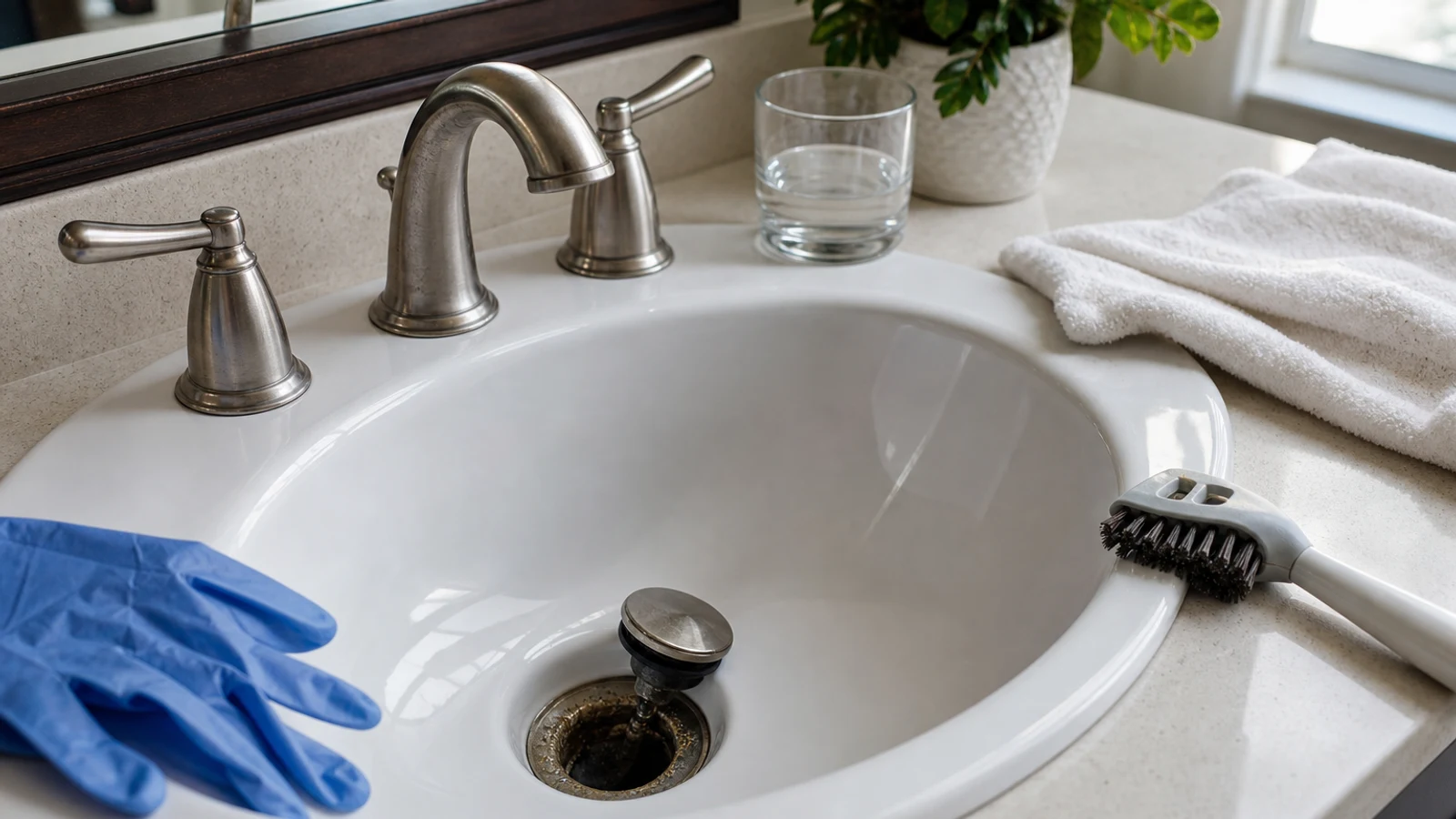
To get rid of drain flies, first identify which drain or damp area is producing them. Cover suspected drains overnight with clear tape or an inverted container so you can see where adults emerge. Then remove the drain cover, scrub away organic buildup from the drain opening and accessible trap surfaces, and use a biological or enzyme drain cleaner exactly as directed. Repeat the treatment and keep the drain dry and clean. If flies continue after several days of source treatment, inspect hidden leaks, floor drains, garbage disposals, condensate lines, crawl spaces, or sewer-line problems, and consider a licensed plumber or pest professional.
What Drain Flies Look Like—and What They Usually Mean
Drain flies, also called moth flies or sewer flies, are tiny insects with fuzzy, moth-like bodies and wings. They are often gray, brown, or nearly black and tend to rest on bathroom walls, sinks, windows, or nearby surfaces rather than flying quickly across a room. They are commonly noticed around bathrooms, kitchens, laundry rooms, basements, and utility areas.
Seeing a few adults does not necessarily mean the entire home has a serious infestation. It does mean that a damp location containing decomposing organic material may be supporting their immature stages. The adults are the visible symptom; the gelatinous film inside a drain, trap, overflow pipe, or other wet area is usually the problem to solve.
Drain flies are primarily a nuisance and do not bite. Because they are associated with organic waste and sewage, you should still clean affected areas and address leaks promptly. Do not assume every tiny fly near a sink is a drain fly, however. Fruit flies are usually attracted to fermenting food and produce, while phorid flies can breed in a wider range of decaying material, including concealed plumbing or structural moisture problems.
- Fuzzy or moth-like appearance
- Usually found resting near drains and damp surfaces
- Often slow-moving compared with fruit flies
- Common around bathroom, kitchen, laundry, and basement drains
- Adults can remain visible after the source has been cleaned
Find the Breeding Source Before You Clean Everything
Treating every drain at once can make it harder to learn where the flies are coming from. Start by listing every possible drain or damp location in the area where you see adults. Include bathroom sinks, shower and tub drains, sink overflow openings, floor drains, laundry standpipes, utility sinks, garbage disposals, condensate drains, and drains that are rarely used.
To test a drain, place a piece of clear tape over the opening with the sticky side facing down, leaving enough space for air movement, or place a clear glass, jar, or similar container over the drain. Check it the next morning and repeat the test if needed. If flies collect beneath the covering, that drain deserves attention. For an overflow channel, cover the opening separately because flies can develop there even when the main drain looks clean.
A drain that tests negative is not automatically cleared. Adult flies can travel from another room, and some infestations originate beneath a sink, under flooring, in a crawl space, or around a leaking pipe. If flies are concentrated near a floor drain or appear after a plumbing backup, treat the location as a possible plumbing issue rather than simply a surface pest problem.
- Test one drain or area at a time
- Check sink overflow openings, not only the main drain
- Inspect rarely used floor and laundry drains
- Look beneath sinks for leaks, damp cabinet bottoms, and food residue
- Note whether flies are strongest near a wall, floor, or plumbing fixture
Clean the Drain Mechanically First
The most important step is removing the organic film where larvae feed. Take off the drain stopper or cover if it can be removed safely. Use a stiff, appropriately sized drain brush or cleaning tool to scrub the inside of the drain opening and accessible surfaces. Pull out hair, soap residue, grease, and other buildup, then clean the stopper and surrounding drain parts before replacing them.
A bathroom sink may also need attention inside its overflow passage. A shower or tub can retain buildup beneath the strainer. A kitchen sink may have residue around the garbage-disposal baffle or in the disposal chamber. A floor drain may require cleaning around the grate and trap area. Do not force a brush into a pipe if it could become lodged or damage a fitting.
Mechanical cleaning is often more useful than simply pouring a liquid into the drain because the breeding film can cling to pipe surfaces. After cleaning, rinse according to the fixture and product instructions. If the drain is slow, repeatedly backs up, or contains standing water that does not clear normally, stop trying to solve the fly problem with household chemicals and investigate the plumbing cause.
- Remove and wash drain covers and stoppers
- Scrub accessible organic buildup from the drain opening
- Clean sink overflow channels when possible
- Inspect garbage-disposal baffles and splash guards
- Do not push tools where they may become stuck
Use Enzyme or Biological Drain Products Carefully
A biological or enzyme drain cleaner may help break down the grease and organic material that remains after physical cleaning. These products are not instant insect repellents. They work, when they work, by reducing the material that supports the larvae. Follow the product label for the correct amount, contact time, frequency, and compatible drain type.
Do not combine drain products. Never mix bleach, acidic cleaners, ammonia, caustic drain openers, or other chemicals. Mixing products can produce dangerous fumes or heat, and a chemical left in the pipe can splash back during later cleaning. Keep children and pets away from treated areas and follow the label’s storage and ventilation instructions.
Hot water, bleach, and conventional chemical drain openers are not dependable substitutes for removing the breeding film. They may temporarily reduce visible insects or alter the drain environment without clearing the buildup attached to the pipe. If you choose a product, use one designed and labeled for the specific drain-cleaning purpose rather than an unapproved household mixture.
- Clean first, then use an appropriate biological or enzyme product if needed
- Follow the label instead of increasing the dose
- Never mix drain chemicals
- Do not pour pesticides into drains unless the product label specifically allows it
- Repeat only as directed
Repeat the Process and Control the Adults
You may continue seeing adult flies for several days after cleaning because adults that have already emerged can remain in the room. Vacuuming or wiping up adults reduces the visible number but does not eliminate the source. Sticky traps placed near, but not inside, the affected area can help monitor activity and catch some adults. Keep traps away from children, pets, food-preparation surfaces, and places where they could be touched.
Retest the suspected drain after cleaning. If flies still appear, inspect the overflow, trap, nearby drains, and concealed wet areas. More than one drain may be active, especially in a bathroom or basement. Continue monitoring until the number of adults declines and the suspected breeding sites remain inactive.
Avoid relying on aerosol sprays as the main solution. A spray may kill exposed adults but will not remove larvae or the organic film in the drain. Source removal is more durable and avoids repeatedly applying pesticides indoors for a problem that may be caused by plumbing or moisture.
- Vacuum or wipe up adults for immediate relief
- Use sticky traps only as monitoring or supplemental control
- Retest treated drains
- Check more than one drain if activity continues
- Expect a short lag after the breeding source is removed
Prevent Drain Flies From Returning
Once the infestation is under control, make the problem less favorable to return. Clean sink stoppers, disposal baffles, shower strainers, and drain covers regularly. Remove hair and food residue before it enters the drain. Fix dripping faucets, leaking P-traps, loose disposal connections, and damp cabinet bases. A persistent leak can create a breeding site outside the visible drain.
Run water through rarely used drains periodically so their traps do not dry out. If a floor drain is unused for a long period, ask a plumber about the correct way to maintain its trap; do not add chemicals or oils unless the fixture and product instructions specifically support it. Keep basement and utility areas dry, and check condensate lines, sump areas, and dehumidifier drainage for stagnant organic material.
In multifamily housing, the source may be in a shared wall, another unit, or a common plumbing line. Report recurring flies to the landlord or property manager, especially when cleaning your own fixtures does not change the activity.
- Clean drain covers and disposal parts regularly
- Repair leaks and damp cabinet areas
- Keep rarely used drain traps from drying out
- Inspect basement, utility, and laundry areas
- Report recurring problems in apartments or condos
When to Call a Plumber or Pest Professional
Call a plumber when flies persist after careful drain cleaning, when a drain repeatedly backs up, when you smell sewage, or when there is evidence of a hidden leak. A plumber may need to inspect a trap, vent, drain line, slab, crawl space, or sewer connection. Persistent activity from a floor drain can be especially important because the source may be below the visible grate.
A licensed pest professional can help when the insect may not be a drain fly, when activity is widespread, or when the breeding source cannot be located. Ask for source identification and inspection rather than starting with routine indoor spraying. If sewage has entered the home, use appropriate protective measures and arrange professional cleanup; contaminated materials may require more than ordinary household cleaning.
Seek medical advice for unusual skin or wound symptoms rather than assuming they are caused by drain flies. Drain flies themselves are not the same as the parasitic flies associated with myiasis, a rare condition in the United States.
- Persistent flies after repeated source treatment
- Sewage odors, backups, or suspected broken lines
- Water damage under floors, cabinets, or walls
- Large numbers in multiple rooms
- Uncertainty about whether the insect is actually a drain fly
When You Probably Do Not Need to Buy Anything
For a small, localized problem, the most useful tools may already be at home: a removable drain cover, disposable gloves, a suitable brush, a vacuum, and a way to monitor the drain. Buying an insect trap or spray before finding the source can create temporary relief without solving the infestation.
A biological drain product can be reasonable when buildup remains after cleaning or when the product is recommended for the fixture, but it is not mandatory for every case. Do not buy a fogger, broad indoor pesticide, or repeated drain chemicals as a first response. If the source is a broken pipe or hidden moisture problem, spending money on insect control without repairing the underlying condition is usually wasted effort.
- Start with inspection and cleaning
- Buy a drain product only if it fits the problem and label
- Avoid foggers and broad pesticide treatments for a localized drain issue
- Spend on plumbing repair when the evidence points to a leak or broken line
Questions & Answers
Practical follow-up questions readers often ask before acting or buying.
How long does it take to get rid of drain flies?
Visible adults may continue appearing for several days after the breeding material is removed. Retest and clean the suspected source, then check nearby drains if activity does not decline. Continued activity after repeated cleaning suggests another breeding site or a plumbing problem.
Will pouring boiling water down the drain kill drain flies?
Boiling or very hot water is not a dependable long-term treatment because it may not remove the organic film attached to the pipe. Mechanical cleaning and, when appropriate, a labeled biological or enzyme product are more useful approaches.
Can drain flies come from a toilet?
They can be associated with wet organic material in or around plumbing, but a toilet is not automatically the source. Test nearby drains and inspect for leaks, damaged seals, sewer odors, or plumbing problems before assuming the toilet itself is breeding them.
Are drain flies dangerous?
Drain flies are generally considered a nuisance and do not bite. Because they are associated with damp organic matter and sewage, clean affected areas and correct the source. Do not confuse ordinary drain flies with the very different parasitic flies associated with myiasis.
Why do drain flies keep coming back after I clean the sink?
The active source may be in the sink overflow, P-trap, shower drain, floor drain, garbage disposal, condensate line, hidden leak, or another room. Adults can also emerge after the first cleaning, so monitor the area and retest drains one at a time.